
Quick Summary
- Strong brand strategies influence real decisions, not just messaging: Apple builds privacy into products, Patagonia connects environmental purpose to company behavior, and IKEA uses its value equation to guide product design, pricing, quality, function, and sustainability.
- The best examples begin with a clear strategic choice: Spotify prioritizes personalization, Dove maintains a distinctive view of real beauty, Airbnb builds around belonging, and Liquid Death deliberately rejects traditional water-category conventions to create recognizable differentiation.
- A campaign becomes strategically meaningful when it expresses a broader brand decision: Old Spice's famous creative worked because it reflected an audience-led repositioning, distinctive personality, and repeated execution—not simply because one advertisement attracted attention.
- Consistency means repeating the strategic logic, not repeating the same execution: Strong brands express one underlying idea across products, experiences, policies, packaging, communication, or community behavior while allowing individual campaigns and tactics to evolve.
- Learn from the decision behind each brand rather than copying its visible execution: The most useful question is what the strategy makes the company choose—and reject. Borrow that decision logic, then create an expression suited to your own audience and market.
The best brand strategy examples reveal more than memorable logos, slogans or campaigns. They show a clear strategic choice that influences what a company creates, how it behaves, what customers experience and what the brand becomes known for.
Apple turns privacy into a product principle. Patagonia lets environmental purpose influence company-level decisions. IKEA builds its value proposition into product design and pricing. Spotify makes personalization both a product advantage and a cultural experience.
While comparing these examples, I found one distinction especially useful: the strongest brand strategies don't stop at messaging. The strategic choice changes something real about the product, experience, policies or recurring decisions.
Here are eight examples worth studying—and, more importantly, what each one actually teaches.
| Brand | Core Strategic Choice | Where It Shows Up | Main Lesson |
|---|---|---|---|
| Apple | Make privacy a core value | Products and services | Turn claims into product behavior |
| Patagonia | Put environmental purpose into business decisions | Ownership, repair, activism | Purpose needs consequences |
| IKEA | Deliver good design at accessible prices | Product development and pricing | Build strategy around clear tradeoffs |
| Spotify | Make personalization central | Product, recommendations, Wrapped | Turn product strengths into brand assets |
| Dove | Challenge narrow beauty standards | Representation and long-term campaigns | Own a point of view consistently |
| Airbnb | Build around belonging | Community standards and experience | Make the promise operational |
| Liquid Death | Reject conventional category codes | Packaging, voice and entertainment | Differentiate at the product level |
| Old Spice | Reframe a legacy brand around audience insight | Voice, creative and interaction | Reposition around a meaningful insight |
What Counts as a Real Brand Strategy Example?
A successful campaign is not automatically a successful brand strategy.
When I evaluate examples like these, I use a stricter test:
There must be a meaningful strategic choice, that choice must influence multiple decisions, and those decisions must reinforce a recognizable position over time.
That matters because copying a famous campaign is very different from understanding the strategy that made the campaign coherent.
1. Apple: Make a Brand Value Part of the Product
The strategic choice
Apple doesn't merely communicate privacy as a promotional benefit. It treats privacy as part of the value its products are supposed to deliver.
Apple describes privacy as one of its core values and says it designs products and services to protect it.
How it shows up
The important part is not the word privacy. It is that the idea affects the product.
Privacy-related protections appear across products and services rather than existing only in an advertising campaign. That makes the brand claim more credible because customers can encounter it through the experience itself.
Why it works
A brand becomes stronger when an important promise is supported by something the company actually builds.
That creates coherence:
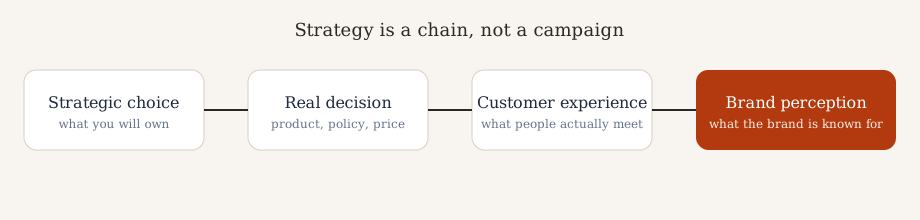
value → product decision → customer experience → brand perception
What to learn
Ask which important brand promise could become a feature, policy, service standard or design decision rather than another line of copy.
Don't copy blindly
Apple's lesson isn't “talk about privacy.” The transferable principle is:
Make an important brand value observable in what you deliver.
2. Patagonia: Let Purpose Change Business Decisions
The strategic choice
Patagonia has made environmental responsibility more than a communications theme.
Its company materials connect the environmental mission to its ownership structure, repair programs, responsibility for impact, grassroots activism and the use of profits for environmental purposes.
How it shows up
The same idea appears in multiple areas:
- what the company publicly stands for;
- how it discusses environmental impact;
- repairing and extending the life of products;
- supporting activism;
- its ownership structure and use of profits.
That is much stronger than attaching a social cause to a seasonal campaign.
Why it works
Purpose becomes strategically meaningful when it influences decisions that would still matter without the advertising around them.
Patagonia has therefore built an unusually tight relationship between:
belief → company behavior → customer expectation
What to learn
If purpose is supposed to be part of your brand strategy, ask:
What would our company do differently because we believe this?
If the answer is “nothing except our messaging,” the purpose probably hasn't become strategy yet.
Don't copy blindly
Your company does not need Patagonia's cause.
The transferable principle is to make your own stated purpose consequential.
3. IKEA: Build the Brand Around a Clear Value Equation
The strategic choice
IKEA's strategy is particularly useful because it demonstrates that brand strategy can live inside product and business decisions.
IKEA describes its “Democratic Design” philosophy through five dimensions:
function, form, quality, sustainability and low price.
How it shows up
Rather than pursuing beautiful design independently of price—or low price independently of usability—IKEA repeatedly tries to solve those variables together.
The distinctive idea is therefore not simply:
“Affordable furniture.”
It is closer to:
Make functional, attractive design accessible to many people while balancing the five requirements together.
Why it works
Strong strategies create useful constraints.
IKEA's five-part value equation gives product teams something to optimize around. The brand promise becomes connected to what gets designed, manufactured and sold.
This is a deeper form of consistency than merely maintaining the same colors or tone of voice.
What to learn
Define the combination of qualities your brand is trying to own.
A useful strategy often sounds less like an adjective and more like a difficult equation:
- high convenience + low complexity
- premium experience + unusual accessibility
- technical capability + beginner-friendly use
Don't copy blindly
“Affordable Scandinavian design” belongs to IKEA.
The transferable lesson is to identify your own value equation and preserve it repeatedly.
4. Spotify: Turn Personalization Into Product and Culture
The strategic choice
Spotify has made personalization a central part of how people experience the service.
The company has described personalization as being at the heart of what it does, historically pointing to experiences such as Discover Weekly and Wrapped.
How it shows up
Personalization exists inside the core product through recommendations and increasingly personalized experiences.
But Spotify also turns that private utility into something public.
Wrapped converts an individual's listening behavior into a personal story that can be shared, discussed and compared.
That connects:
product capability → personal identity → social expression → brand culture
Why it works
Wrapped isn't powerful simply because it is a clever annual campaign.
It is powerful because the campaign grows naturally from something Spotify already does at the product level: understand and personalize listening.
The marketing therefore amplifies the product rather than inventing an unrelated story around it.
What to learn
Look for something valuable your product already knows, does or enables.
Then ask whether it can become a recognizable part of how customers express themselves through the brand.
Don't copy blindly
Building “your own Wrapped” without the underlying product value usually produces a gimmick.
Copy the connection between product strength and brand expression, not the format.
5. Dove: Own a Point of View Long Enough for It to Mean Something
The strategic choice
Dove's Real Beauty strategy challenges narrow and unrealistic beauty standards rather than presenting the category's traditional idealized version of beauty.
The platform dates to 2004, and Dove has continued updating the idea rather than abandoning it for a completely different position.
How it shows up
The strategic idea affects:
- who appears in brand communication;
- how those people are represented;
- the issues Dove chooses to address;
- research and educational initiatives;
- newer policies surrounding digitally generated beauty imagery.
Why it works
Consistency does not mean repeating the same campaign forever.
Dove keeps the underlying position recognizable while adapting its expression to newer issues.
That is a useful distinction:
Strategy stays relatively stable. Execution evolves.
What to learn
A brand does not need a new fundamental position every time culture, technology or media changes.
Sometimes the stronger move is asking:
What does our existing position mean under the new conditions?
Don't copy blindly
Do not attach your brand to a cultural issue because another purpose-driven brand did.
A point of view needs a credible relationship with your category, audience and behavior.
6. Airbnb: Make the Brand Promise Affect the Experience
The strategic choice
Airbnb has long organized its brand around the idea of belonging rather than framing the service simply as accommodation inventory.
More importantly, the idea has consequences beyond its advertising.
Airbnb connects its purpose of helping create a world where anyone can belong anywhere with its Community Commitment and anti-discrimination standards for platform participants.
How it shows up
The promise influences how Airbnb talks about:
- hosts and guests;
- community;
- connection;
- acceptable behavior on the platform;
- discrimination and inclusion.
That matters because “belonging” would be a weak brand promise if the experience itself tolerated behavior directly opposed to it.
Why it works
For service and platform brands especially, customers experience the brand partly through other people.
The strategy therefore cannot live solely in corporate communication. Policies, standards and community design become part of brand execution.
What to learn
Take your central promise and ask:
- What behavior would contradict this promise?
- Then determine whether your product rules, customer service, policies and experience protect against that contradiction.
Don't copy blindly
“Belonging” is Airbnb's territory.
The lesson is to make your own promise visible in the rules and experience surrounding the service.
7. Liquid Death: Break the Category's Expected Codes
The strategic choice
Water brands traditionally tend to borrow from familiar ideas such as purity, hydration, nature, wellness or minimalism.
Liquid Death deliberately moved in another direction.
Founder Mike Cessario has explained that he wanted to build a healthy beverage company marketed with the entertainment and attitude normally associated with beer or junk-food brands.
How it shows up
The difference is built into:
- the Liquid Death name;
- tallboy-style cans;
- skull-heavy visual identity;
- irreverent language;
- entertainment-focused marketing.
The product was designed from the beginning to attract attention rather than relying on advertising to create all the distinctiveness later.
Why it works
Liquid Death creates distinctiveness by breaking category conventions while remaining internally coherent.
A customer can understand that something is different before reading a positioning statement.
While reviewing this example, I think this is one of the clearest distinctions between real differentiation and cosmetic differentiation: the difference starts in the product and packaging, not just in the ads.
What to learn
List the conventions in your category:
- how competitors look;
- what vocabulary they use;
- what benefits they emphasize;
- what personality they adopt;
- what customers expect them to sound like.
Then ask which convention can be rejected in a way that is meaningful to your audience.
Don't copy blindly
Randomly being provocative is not differentiation.
Liquid Death's lesson is not “be edgy.” It is:
Understand your category's codes well enough to break the right ones deliberately.
8. Old Spice: Reposition Around a Better Audience Insight
The strategic choice
Old Spice is useful because it also clarifies when a famous campaign can legitimately appear in a brand-strategy article.
Wieden+Kennedy's original case explains that the team worked from an important audience insight: women accounted for a substantial share of body-wash purchasing, so the campaign was designed to create a conversation involving couples rather than speaking only to men.
“The Man Your Man Could Smell Like” then gave the brand an unmistakably exaggerated, humorous personality.
How it shows up
The initial campaign was followed by an interactive response program in which the team rapidly created individual video responses to people across social platforms.
The strategic importance is therefore not simply that one advertisement became popular.
The useful lesson is the combination of:
audience insight → repositioned conversation → distinctive personality → repeated execution
Why it works
A legacy brand can become newly relevant without discarding everything it has built.
Sometimes repositioning requires changing who the brand is speaking with and how the existing product is framed, rather than creating an entirely new company identity.
What to learn
Before redesigning a brand because it feels dated, investigate whether the deeper problem is:
- the audience being addressed;
- the competitive frame;
- the tone;
- the cultural context;
- or the benefit being emphasized.
The brand may need a new position or expression rather than a new identity from scratch.
Don't copy blindly
Old Spice's humor belongs to Old Spice.
The transferable principle is to find the audience insight that makes a different brand conversation possible.
What These Brand Strategy Examples Have in Common
After comparing these examples, I see four patterns that separate the strongest strategies from brands that simply have good marketing.
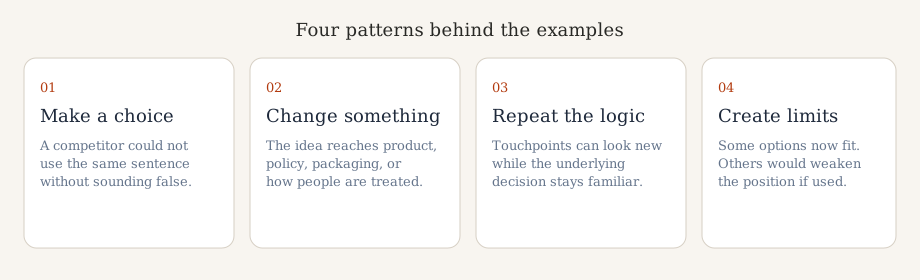
1. They make a choice
Apple emphasizes privacy. IKEA protects a particular value equation. Liquid Death deliberately rejects familiar water-brand conventions.
A strategy cannot meaningfully differentiate a brand if it could describe every competitor.
2. The choice changes something real
The idea influences products, policies, experiences, packaging, community behavior or recurring communication.
That is what separates strategy from an attractive presentation.
3. Different touchpoints reinforce the same idea
Spotify's personalization works in the product and in Wrapped. Patagonia's environmental position appears in more than advertising. Airbnb's belonging promise connects with platform standards.
The execution can change while the underlying logic remains recognizable.
4. The strategy creates constraints
This is the pattern I find most useful when judging whether something is actually a strategy.
Real strategy means some choices fit and others do not.
An IKEA product cannot simply become expensive because premium pricing is fashionable. Patagonia cannot treat environmental purpose as optional whenever it becomes inconvenient without weakening the position. Liquid Death cannot suddenly sound like a generic wellness-water brand without giving up much of its distinctiveness.
That constraint is a feature, not a flaw.
How I Learn From Brand Strategy Examples Without Copying Them?
When I analyze another brand, I try to ignore the most visible execution first.
Instead of asking:
“How can we look more like Apple?”
or:
“How can we market like Liquid Death?”
I find it more useful to ask:
- What strategic choice has this brand made?
- Which recurring decisions prove that choice is real?
- What customer perception does that combination create?
- What does the strategy force the company to say no to?
- What equivalent choice would make sense for our audience, product and market?
The mistake I would avoid is copying the thing that is easiest to see—the visual style, campaign format, tone or slogan—while missing the strategic decision underneath it.
Borrow the decision logic. Build your own expression.
Frequently Asked Questions
What are the best brand strategy examples?
Apple, Patagonia, IKEA, Spotify, Dove, Airbnb, Liquid Death, and Old Spice are useful examples because they demonstrate different strategic choices rather than variations of the same tactic. The strongest examples show how positioning or values influence products, experiences, policies, packaging, or recurring communication—not just advertising.
What is a simple example of brand strategy?
IKEA is a simple example: it aims to combine function, attractive design, quality, sustainability, and low prices rather than optimizing only one of those qualities. That strategic value equation influences what IKEA designs and sells, showing how brand strategy can guide real business decisions rather than merely messaging.
What are some good brand strategy examples from newer brands?
Liquid Death is a strong newer-brand example because it entered a conventional water category with deliberately unconventional packaging, personality, and entertainment-led communication. The important lesson is not to imitate its edgy style, but to identify category conventions your brand can meaningfully challenge.
Are there good B2B brand strategy examples?
Yes. IBM is a useful B2B example because its long-running idea of using technology to drive progress has remained recognizable even as the company has repeatedly reinvented its products and business. Cisco similarly connects brand principles with how employees are expected to behave and serve customers.
What are examples of brand strategy in marketing?
Old Spice and Spotify show how marketing can express a larger brand strategy. Old Spice used audience insight and a distinctive personality to reposition the brand, while Spotify Wrapped turns the product's personalization capability into shareable marketing. The campaign works strategically because it reinforces an underlying brand choice rather than standing alone.