
Quick Summary
- Operational CRM focuses on action, while analytical CRM focuses on insight: Operational CRM manages and automates customer-facing activities such as sales follow-ups, marketing workflows, and service tasks, while analytical CRM examines customer data to identify patterns, trends, and opportunities.
- The main difference is how each system uses customer data: Operational CRM records and supports day-to-day interactions, while analytical CRM combines accumulated data to produce segmentation, forecasts, performance insights, and predictions that support better decisions.
- Operational CRM is best for improving workflow efficiency: Businesses commonly use it for lead assignment, pipeline management, campaign automation, follow-up tasks, customer service ticketing, and other repeatable processes that need consistent execution.
- Analytical CRM is best for understanding customer behavior and performance: It can help identify valuable customer segments, conversion trends, churn risks, purchasing patterns, and sales opportunities by analyzing data collected across customer interactions.
- Businesses often need both rather than choosing only one: Operational activity generates much of the data used by analytical CRM, while analytical insights can improve future operational actions. Many modern CRM platforms therefore combine both capabilities in one system.
Operational CRM vs Analytical CRM: How are they Different?
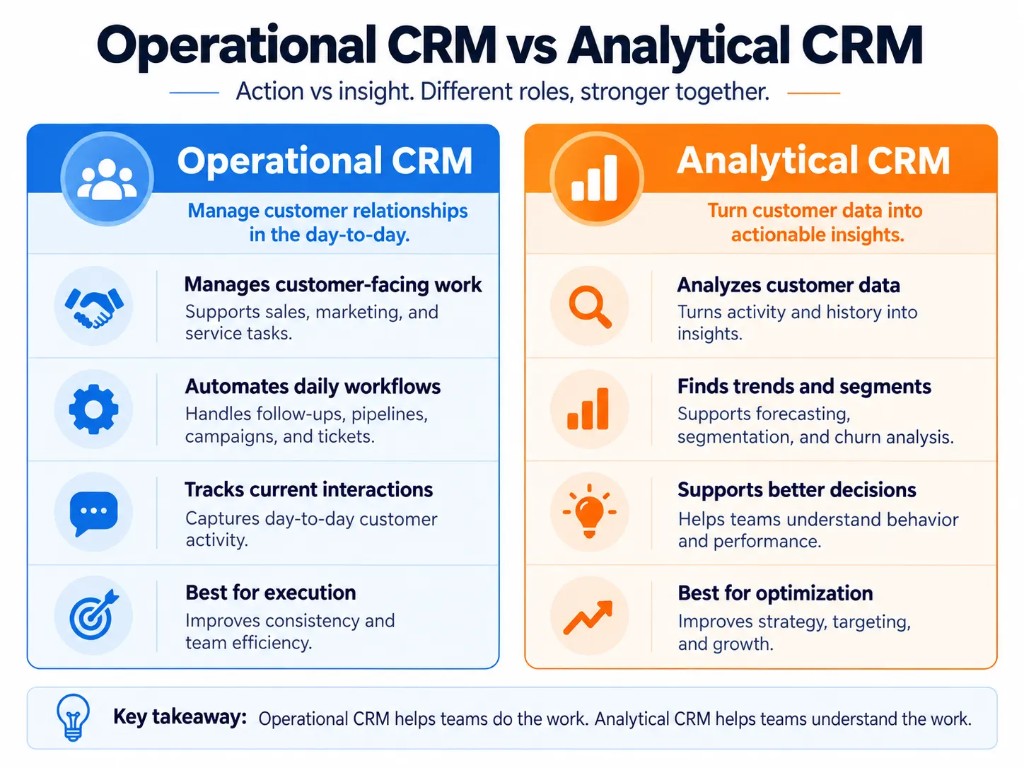
Operational CRM helps a business manage and automate customer-facing work, while analytical CRM examines customer data to generate insights for better decisions.
The simplest distinction is:
- Operational CRM = system of action.
- Analytical CRM = system of insight.
Operational CRM handles activities such as lead assignment, sales follow-ups, marketing campaigns and customer-service workflows. Analytical CRM looks across customer data to identify patterns, segments, trends and predictions.
The two are complementary rather than mutually exclusive. CRM research describes operational CRM as the automation of customer-facing sales, marketing and service processes, while analytical CRM develops and uses customer data to support strategic and tactical decisions. Analytical insights can then be fed back into customer-facing activity.
| Difference | Operational CRM | Analytical CRM |
|---|---|---|
| Primary purpose | Execute and automate customer-facing processes | Turn customer data into insight |
| Main question | What needs to happen with this customer next? | What does our customer data tell us? |
| Typical users | Sales reps, marketers, service teams | Managers, analysts, sales and marketing leaders |
| Main focus | Day-to-day execution | Analysis and decision-making |
| Common functions | Lead management, workflow automation, campaign execution, service ticketing | Segmentation, forecasting, pattern analysis, predictive analytics, reporting |
| Data use | Primarily current interaction and transaction data | Primarily accumulated data from interactions and other sources |
| Typical output | An action, update, task or workflow | An insight, forecast, segment or recommendation |
| Best fit | Teams struggling with manual work or inconsistent processes | Teams that have data but need to understand patterns and performance |
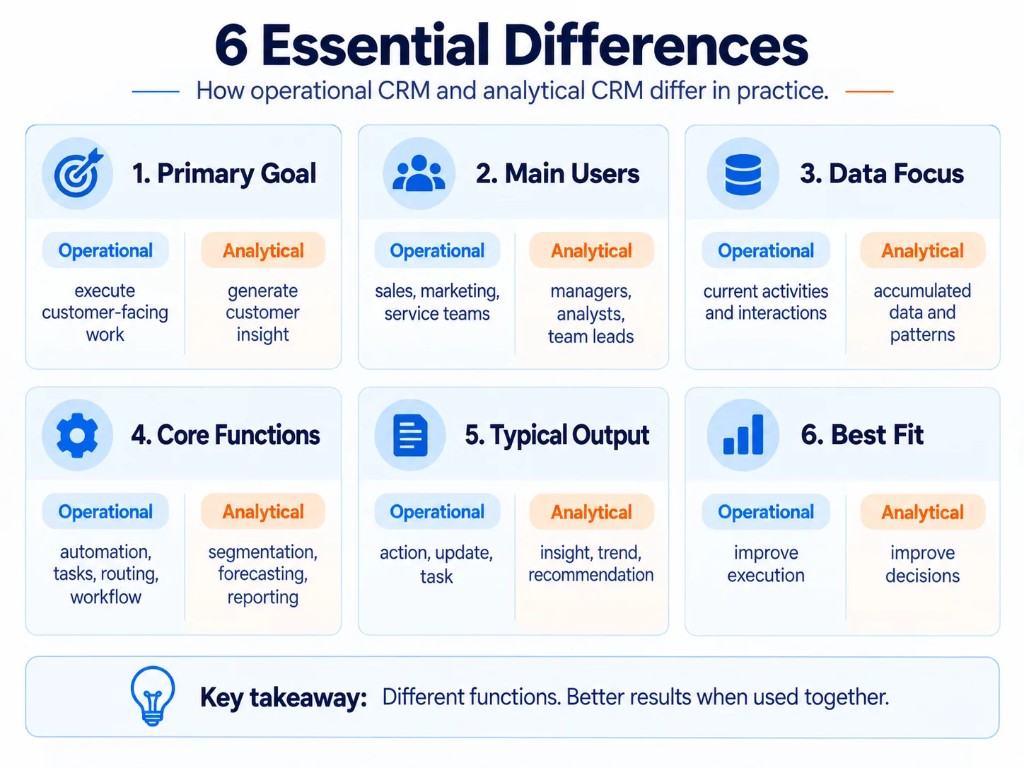
One qualification matters: “current data versus historical data” is useful shorthand, not a hard boundary. Modern analytical capabilities can generate insights quickly or surface predictions inside an operational workflow. The more reliable distinction is what the CRM is doing: executing a process or analyzing information.
Operational CRM: What It Does?
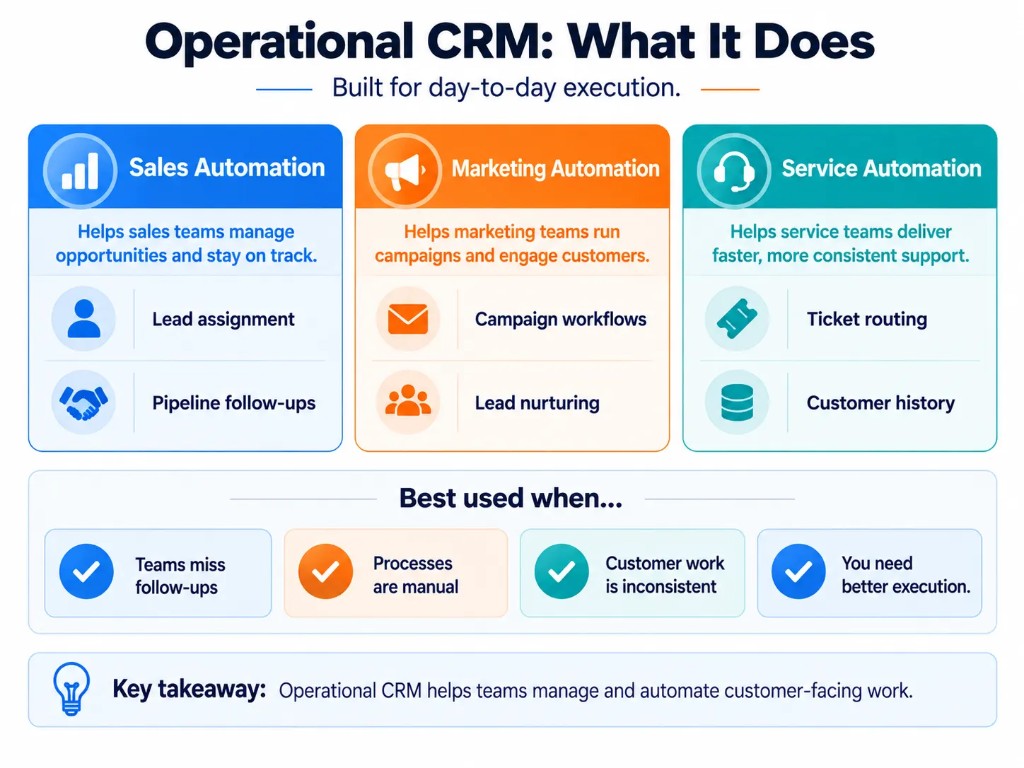
Operational CRM supports the activities employees perform while acquiring, serving and retaining customers.
Its three classic areas are sales automation, marketing automation and service automation. Oracle and Commence both describe these as central operational CRM functions.
Sales automation can assign leads, update opportunities, schedule follow-ups and track customer interactions.
Marketing automation can trigger campaigns, nurture leads and respond to customer behavior.
Service automation can route support cases, maintain interaction histories, escalate tickets and send follow-up communications.
The emphasis is not primarily on discovering a hidden pattern in thousands of customer records. It is on making the next customer-facing process happen efficiently and consistently.
Operational CRM Example
Suppose someone completes a quote form on a company's website.
An operational CRM might:
- create the contact;
- assign the lead to the correct salesperson;
- send an acknowledgement email;
- create a follow-up task;
- move the opportunity through pipeline stages;
- store calls and emails on the customer record.
The CRM is performing and coordinating work.
That is operational CRM.
Analytical CRM: What It Does
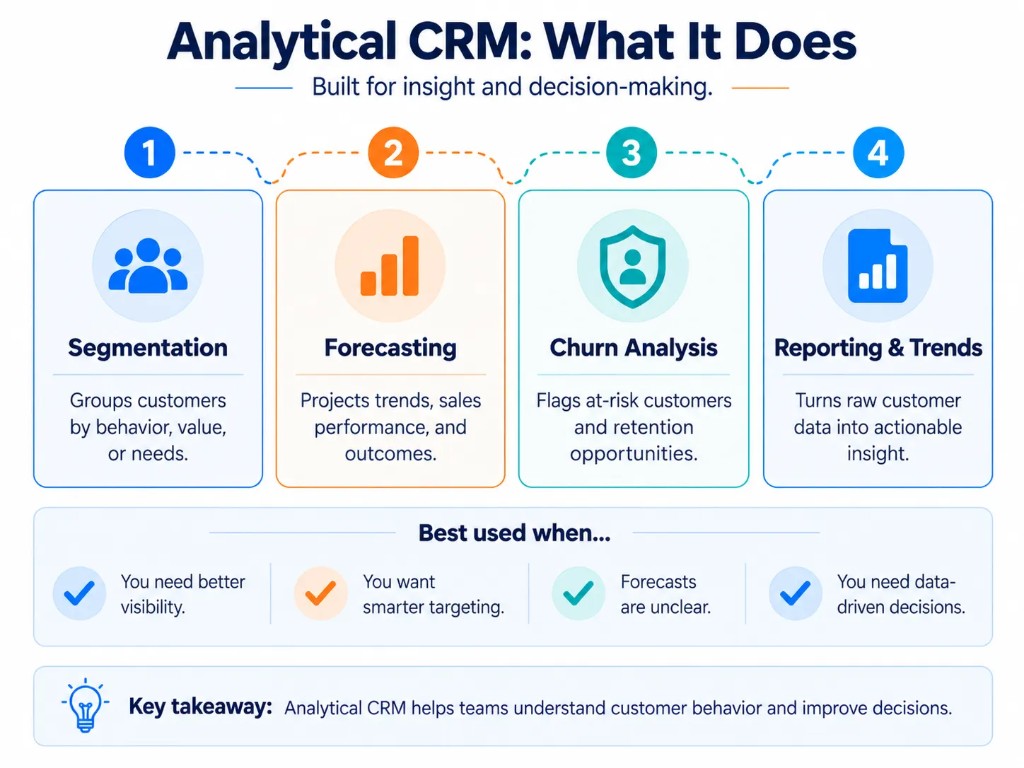
Analytical CRM takes customer-related data and asks what can be learned from it.
That can include data from sales interactions, purchases, marketing campaigns, service conversations, digital touchpoints and other connected sources.
Common analytical functions include:
- customer segmentation;
- data mining and pattern recognition;
- sales forecasting;
- predictive analytics;
- churn or conversion analysis;
- performance analysis and reporting.
Salesforce describes analytical CRM as analyzing information from customer interactions to understand behaviors, preferences and buying patterns. TechTarget similarly defines its goal as transforming customer data into trends and actionable insights.
Analytical CRM Example
Imagine the same company has collected six months of lead and sales data.
Its analytical CRM might discover that:
- leads from one acquisition channel convert at a higher rate;
- customers in a particular segment tend to buy a second product within 90 days;
- stalled opportunities with certain characteristics rarely close;
- a group of existing customers shows signs associated with churn.
The output is not simply another customer record.
It is an insight that changes a decision.
The company might then use those findings to prioritize particular leads, target a customer segment or intervene with an at-risk account.
How Operational and Analytical CRM Work Together?
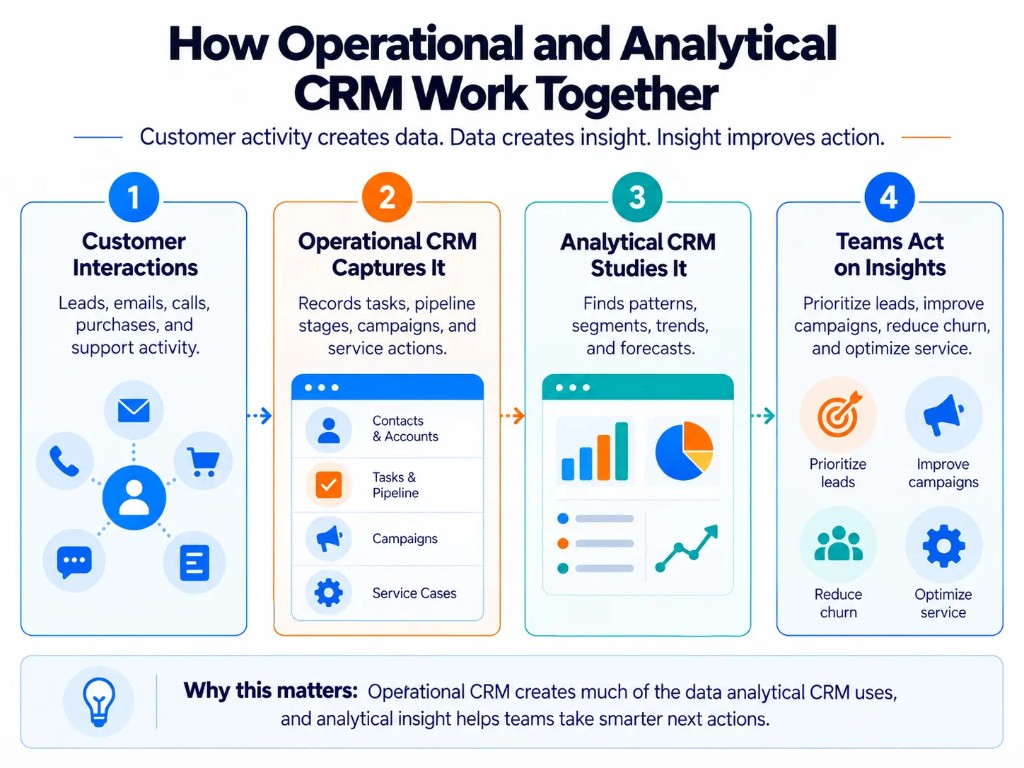
Operational and analytical CRM are best understood as parts of a feedback loop.
1. Operational CRM creates activity.
Customers submit forms, receive campaigns, speak with salespeople, make purchases and contact support.
2. Those interactions create customer data.
The CRM records activities, stages, outcomes, responses and transactions.
3. Analytical CRM studies that data.
It identifies patterns, segments, trends, relationships or predictions.
4. The insight changes the next operational action.
A high-propensity lead can be prioritized. An at-risk customer can receive proactive outreach. A high-performing segment can receive a more relevant campaign.
Academic CRM research describes this relationship explicitly: analytical CRM can develop customer information that is subsequently delivered back to customer touchpoints and channels to improve operational CRM activity.
This also explains why analytical CRM depends on the quality of its inputs.
If sales stages are inconsistent, important interactions are never logged, duplicate customers are common or critical fields have different meanings across teams, the resulting analysis can be misleading. TechTarget specifically notes that analytical insights are only as reliable as the underlying data.
This concern also appears repeatedly in practitioner discussions. RevOps users report that bad CRM data can produce forecasts and dashboards that look credible while being wrong. Those reports are anecdotal rather than controlled evidence, but they illustrate the practical consequence of poor operational data capture.
Which One Should You Prioritize?
Neither type is universally better. The right priority depends on the problem you are trying to solve.
| Your problem | Prioritize |
|---|---|
| Sales reps miss follow-ups | Operational CRM |
| Leads are manually assigned | Operational CRM |
| Customer-service work is inconsistent | Operational CRM |
| Marketing workflows require repeated manual work | Operational CRM |
| You cannot identify which customers are most valuable | Analytical CRM |
| You need better segmentation | Analytical CRM |
| You have substantial customer data but cannot explain conversion or churn patterns | Analytical CRM |
| You need forecasting or deeper customer analysis | Analytical CRM |
| Your analytical reports are unreliable because CRM records are inconsistent | Improve the operational/data foundation first |
| You need both efficient execution and data-driven decisions | Use both capabilities |
For an organization with little CRM structure, operational capability usually needs to exist first because customer activities must be captured consistently before deeper analysis becomes useful.
If operational processes already work well and the organization has accumulated reliable customer data, stronger analytical capabilities become much more valuable.
That does not mean analytical CRM is simply a more advanced version of operational CRM. They solve different problems.
Can One CRM Be Both Operational and Analytical?
Yes.
Operational and analytical CRM are better understood as functional categories than mutually exclusive product categories.
A modern CRM platform might let a salesperson manage opportunities and automate follow-ups while also giving managers segmentation, forecasting and predictive insight.
Salesforce says modern CRM platforms can incorporate operational, analytical, collaborative and strategic capabilities in one system. SugarCRM and Oro similarly describe operational and analytical functions working together.
This is why labeling an entire vendor “operational” or “analytical” can become misleading.
A reporting dashboard also does not automatically turn an operational system into a dedicated analytical CRM. The useful question is what the capability actually does.
If it primarily records, coordinates or automates customer activity, it is operational.
If it primarily analyzes accumulated customer information to reveal patterns, predictions or decision-supporting insights, it is analytical.
Many modern CRM systems do both.
Frequently Asked Questions (FAQs)
Can a CRM be both operational and analytical?
Yes. Many modern CRM platforms combine operational features such as lead management and workflow automation with analytical features such as reporting, segmentation, forecasting, and predictive insights. The categories describe what the CRM is doing, not necessarily separate software products.
Is CRM an analytical tool?
A CRM can include analytical capabilities, but CRM software is not automatically an analytical CRM. Features that examine accumulated customer data to identify trends, segments, forecasts, or predictions are analytical; features that record interactions or automate customer-facing work are primarily operational.
Which types of data does analytical CRM collect and analyze?
Analytical CRM can use purchase histories, sales interactions, marketing responses, support activity, customer profiles, and other behavioral or transactional data. It combines these records to identify patterns such as customer segments, buying behavior, conversion trends, churn risk, and sales opportunities.
What happens after analytical CRM systems complete their analysis?
The resulting insights are used to improve business decisions and customer-facing actions. For example, an identified high-value segment may receive a targeted campaign, a high-propensity lead may be prioritized by sales, or a customer showing churn risk may trigger proactive outreach.
What does an operational CRM system typically support?
Operational CRM typically supports sales, marketing, and customer-service processes such as lead tracking, pipeline management, follow-up tasks, campaign automation, and service ticketing. Its primary role is to help customer-facing teams execute day-to-day work consistently and efficiently.
Can poor operational CRM data affect analytical CRM results?
Yes. Analytical CRM depends on the quality and consistency of the customer data available to it, much of which originates from operational activity. Missing interactions, inconsistent sales stages, duplicate records, or unreliable fields can produce misleading reports, forecasts, and customer insights.