
Quick Summary
- CRM system proficiency means independent, accurate system use: A proficient CRM user can manage customer records, log interactions, track leads or accounts, handle follow-ups, and complete role-specific workflows without needing constant guidance.
- Practical ability matters more than simply knowing the software: Employers usually care about what you can actually do inside a CRM—such as maintaining data, managing pipelines, using reports, and following workflows—rather than whether you recognize the interface or terminology.
- Proficiency exists at different levels: Basic users handle records and navigation, proficient users independently manage routine workflows, while advanced users may create reports, dashboards, automations, integrations, or troubleshoot more complex CRM processes.
- Experience with one CRM can transfer to another: Skills such as contact management, pipeline tracking, activity logging, reporting, and workflow management often transfer between Salesforce, HubSpot, Zoho, Dynamics, and other platforms, though platform-specific proficiency still requires direct experience.
- Prove proficiency with tasks, not vague claims: On a resume or in an interview, name the CRM platforms you used and describe the work you performed. Hands-on examples provide stronger evidence than simply writing “CRM proficient” or relying on certification alone.
What Does CRM System Proficiency Mean?
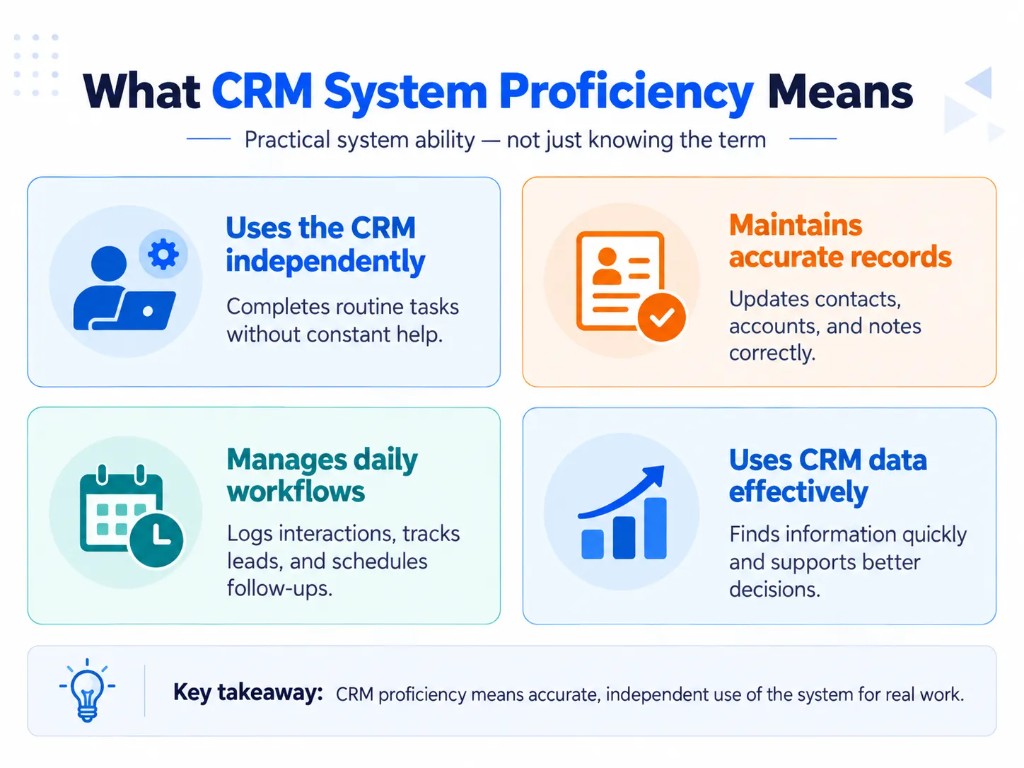
Being CRM proficient is more than recognizing the interface or knowing what a CRM does.
A proficient user can normally perform the CRM tasks expected in their job correctly, consistently and with limited assistance.
For example, that might mean being able to:
- find and update customer or account records;
- enter information in the correct fields;
- log calls, emails, meetings and other interactions;
- create or manage leads, contacts, accounts and opportunities;
- update lead or deal stages;
- schedule tasks and follow-ups;
- find previous customer activity quickly;
- use saved views, filters or searches;
- generate or interpret basic reports;
- follow the organization's rules for keeping CRM data accurate.
Current sales job descriptions illustrate this clearly. One requires users to quickly access, verify and update contact details, while another describes CRM proficiency as logging interactions, managing pipelines, tracking lead status and following up effectively.
So if a job description says “CRM system proficiency required,” the employer is generally asking whether you can actually work inside a CRM—not whether you know the definition of customer relationship management.
What Skills Demonstrate CRM Proficiency?
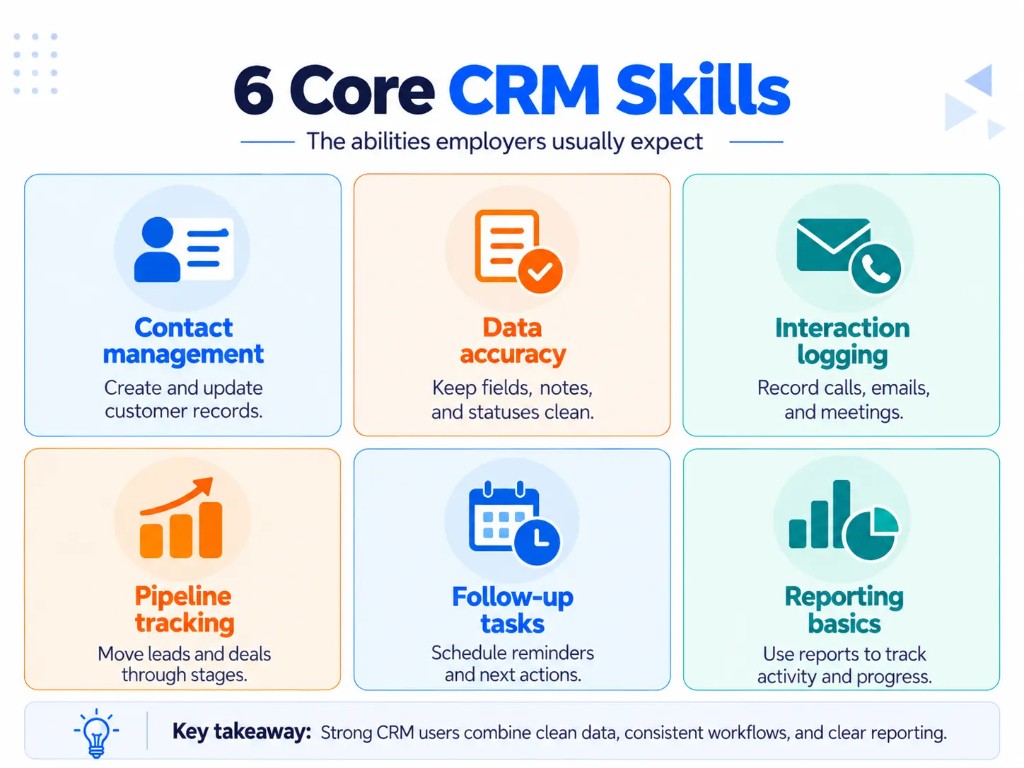
CRM proficiency combines several related abilities.
| CRM skill | What it looks like in practice |
|---|---|
| System navigation | Finding contacts, accounts, deals, activities and reports without struggling through the interface |
| Record management | Creating and updating records accurately and using the correct fields |
| Data quality | Avoiding duplicates, incomplete records and incorrect status information |
| Interaction tracking | Logging calls, emails, meetings, notes and customer activity consistently |
| Lead and pipeline management | Updating stages, assigning leads, tracking opportunities and keeping next steps current |
| Task management | Creating reminders, follow-ups and activities so work is not missed |
| Search and filtering | Locating the right customers, leads or accounts using views, filters and search |
| Reporting | Reading or creating reports and dashboards relevant to the role |
| Workflow understanding | Knowing how records move through the organization's sales, service or marketing process |
| Automation | Using or configuring automated tasks, alerts or workflows when the role requires it |
| Integrations | Understanding how the CRM exchanges data with email, marketing, support or other systems |
Modern CRM platforms commonly combine contact management, interaction tracking, sales pipeline management, automation, reporting and analytics.
You do not need advanced knowledge of every function to call yourself CRM proficient. The required skills depend on what you are expected to accomplish with the system.
CRM Proficiency Levels: Beginner vs Proficient vs Advanced
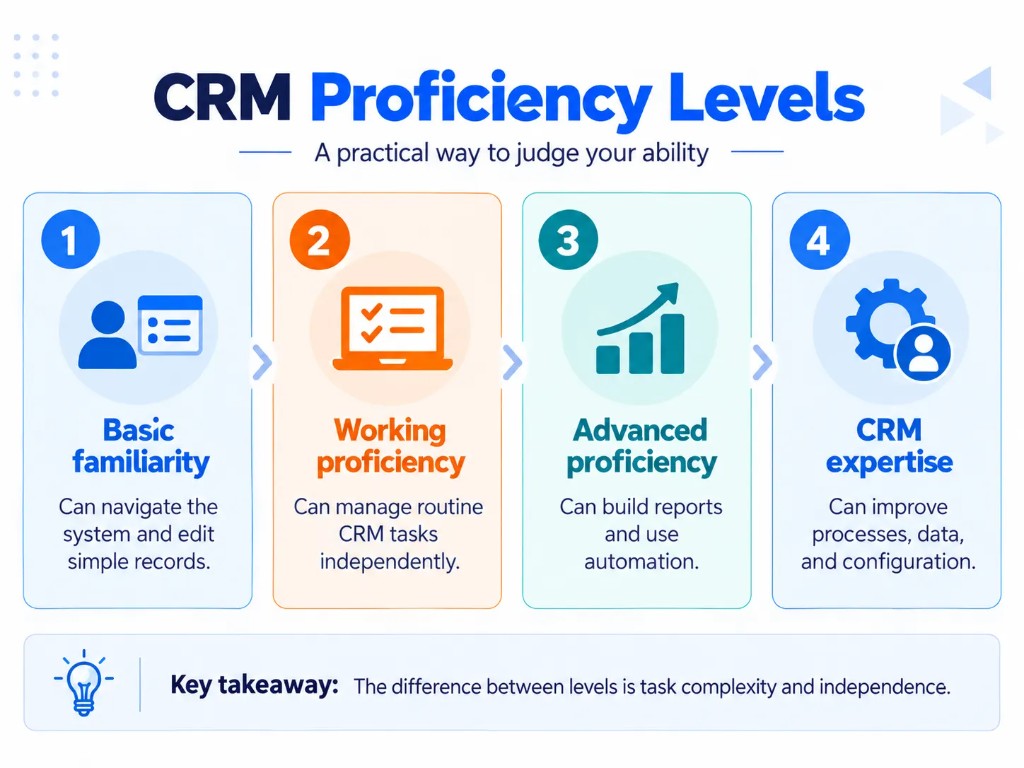
There is no universal industry standard that divides CRM users into exact proficiency levels. A practical way to assess yourself is by considering how complex the tasks are and how independently you can perform them.
| Level | What you can typically do |
|---|---|
| Basic familiarity | Navigate the CRM, find records, update simple fields and understand common objects such as contacts and leads |
| Working proficiency | Independently maintain records, log activities, manage leads/accounts, update pipelines, schedule follow-ups and use routine reports |
| Advanced proficiency | Build reports or dashboards, troubleshoot data/process issues, work with automation, configure workflows or support more complex team processes |
| CRM expertise | Design processes, administer/configure systems, manage integrations, govern data or optimize CRM architecture for business requirements |
The important boundary is usually between familiarity and working proficiency.
If someone has shown you where to click a few times, you have CRM exposure.
If you can complete the normal CRM workflow for your job independently and accurately, you can more reasonably describe yourself as proficient.
Advanced proficiency is role-dependent. A sales representative may be highly proficient without ever configuring an API or designing an automation workflow.
What CRM Experience Do Employers Usually Mean?
“CRM experience” normally means that you have actually used a CRM to complete work.
That experience may come from employment, an internship, freelance work, volunteer work, structured projects or realistic hands-on practice.
What matters most is what you did inside the system.
For example:
“Six months of Salesforce experience”
provides less information than:
“Used Salesforce to maintain account records, log sales activities, manage opportunities through pipeline stages and prepare weekly pipeline reports.”
The second statement shows the actual scope of the experience.
CRM Proficiency by Business Function
Different teams use the same CRM differently.
| Function | Typical proficiency may involve |
|---|---|
| Sales | Leads, contacts, opportunities, pipeline stages, activities, follow-ups and forecasts |
| Customer service | Customer history, cases/tickets, communication logs, escalations and resolutions |
| Marketing | Segmentation, campaign records, lead information, customer activity and marketing automation |
| Operations / account management | Record accuracy, account updates, reporting, workflow coordination and data quality |
Salesforce's own CRM training similarly spans customer data management, lead management, sales automation, marketing integration, customer support and reporting rather than treating CRM proficiency as a single isolated skill.
For deeper coverage of each workflow, see the separate guides to CRM for sales teams, CRM customer service, CRM for digital marketing and CRM data entry.
CRM Experience vs CRM Proficiency vs CRM Expertise
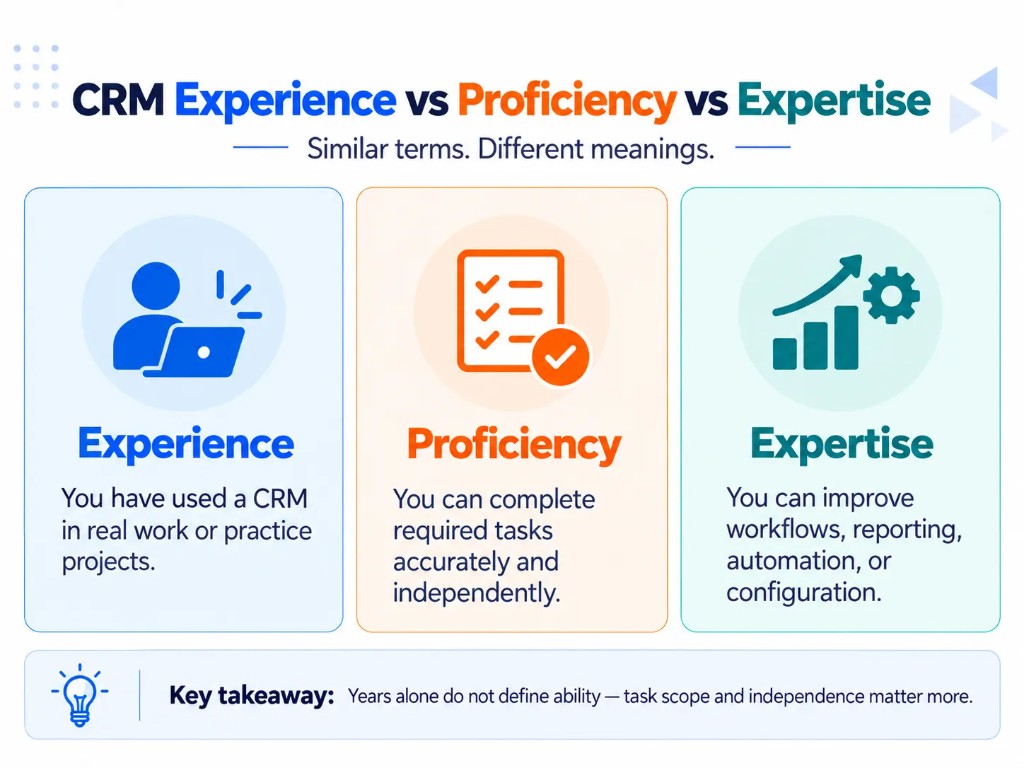
These terms overlap, but they are not identical.
| Term | Best interpretation |
|---|---|
| CRM exposure | You have seen or briefly used a CRM |
| CRM experience | You have completed real or realistic work inside a CRM |
| CRM proficiency | You can perform the CRM tasks required by your role independently and reliably |
| CRM expertise | You can handle complex configuration, processes, analysis, administration or optimization |
Someone can therefore have two years of CRM experience without being advanced, while another person may become proficient relatively quickly if their experience involves frequent, complex hands-on use.
Years of experience are useful context, but task complexity and independence reveal more about actual capability.
How Do You Know If You're CRM Proficient?
Ask yourself whether you could be given a normal CRM task for your role and complete it without someone guiding you through every step.
You are probably at a working-proficiency level if you can answer yes to most of these questions:
- Can I locate the correct contact, account or lead quickly?
- Can I create and update records without corrupting or duplicating data?
- Can I log customer interactions correctly?
- Can I understand the organization's lead, deal, account or service workflow?
- Can I update statuses and stages accurately?
- Can I identify what follow-up or next action is required?
- Can I use filters, searches and saved views?
- Can I retrieve the information needed by colleagues or customers?
- Can I use routine CRM reports relevant to my job?
- Can I recognize when CRM data appears incomplete or incorrect?
- Can I perform these tasks without constant supervision?
For more technical roles, add questions about dashboards, imports, workflow automation, permissions, integrations and troubleshooting.
The objective is not to check as many features as possible. It is to determine whether you can complete the workflows your job depends on.
Does Experience With One CRM Transfer to Another?
Usually, yes—at least partially.
Salesforce, HubSpot, Zoho CRM, Microsoft Dynamics 365, Pipedrive, SuiteCRM and other platforms have different interfaces and terminology, but many underlying concepts transfer:
- contacts and accounts;
- leads and opportunities;
- pipeline stages;
- activity history;
- tasks and follow-ups;
- reports;
- fields and records;
- workflows;
- permissions;
- data quality.
That means experience using one CRM is genuine CRM experience even when a prospective employer uses another platform.
It does not, however, automatically make you proficient in the employer's specific platform.
This distinction appears directly in job-seeker discussions. One person with SuiteCRM experience questioned whether Salesforce certification was needed for jobs requesting Salesforce proficiency, reflecting the common tension between transferable CRM knowledge and platform-specific requirements.
When a job description says:
“CRM experience required”
your experience with another CRM may satisfy the requirement.
When it says:
“Advanced Salesforce proficiency required”
the employer is more likely to expect platform-specific knowledge.
The strongest approach is therefore to describe both:
transferable CRM tasks + platforms actually used.
How to Show CRM Proficiency on a Resume or in an Interview?
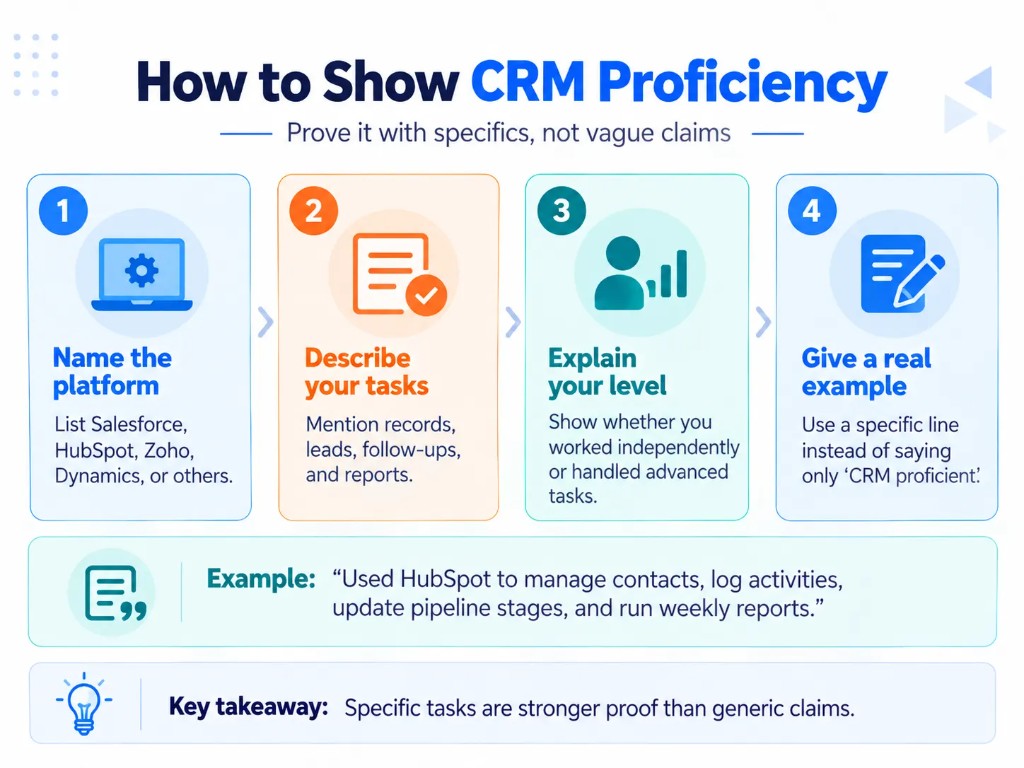
Avoid writing only:
CRM proficient
or:
- Salesforce — proficient
- Those claims give an employer little evidence.
- Instead, describe what you can do.
Resume skills example
CRM: Salesforce and HubSpot — contact and account management, pipeline tracking, activity logging, follow-up management and reporting.
Experience example
Maintained CRM records for prospects and customers, logged sales interactions, updated opportunity stages and tracked follow-up activities to keep pipeline information current.
More advanced example
Managed CRM reporting and data-quality workflows, created dashboards and automated routine lead-routing and follow-up processes.
Indeed's relevant job-search guidance similarly recommends matching skills to the job posting and using the cover letter or interview to add specific detail about software training and previous application.
In an interview, be ready to explain:
- which CRM platforms you have used;
- which tasks you performed;
- how independently you performed them;
- how frequently you used the system;
- what reports, workflows or automation you handled;
- how you maintained accurate customer information.
If asked “Which CRM systems are you proficient in?”, name the platforms first and then establish your capability:
“I have primarily worked with HubSpot and Zoho CRM. My regular work included managing contact and company records, tracking leads through pipeline stages, logging customer activity, scheduling follow-ups and running sales reports. Because those workflows are transferable, I can usually adapt to another CRM quickly, although I would not claim Salesforce-specific proficiency until I had worked in Salesforce directly.”
That answer is more credible than simply describing yourself as an “expert.”
How to Build CRM Proficiency Without a CRM Job?
You can develop meaningful CRM ability without already holding a CRM-focused position, but passive learning is not enough.
Use a training or practice environment and simulate a complete workflow:
- Create sample contacts and companies.
- Add leads or opportunities.
- Record calls, emails and notes.
- Move opportunities through pipeline stages.
- Create tasks and follow-ups.
- Filter and segment records.
- Produce a simple report or dashboard.
- Practice correcting inaccurate or duplicate data.
- Experiment with a basic workflow or automation if available.
Salesforce, for example, provides hands-on CRM learning through Trailhead and currently covers customer data, lead management, sales automation, marketing integration, service and reporting.
Certification can strengthen evidence that you have studied a particular platform, especially when an employer names it. But certification and proficiency are not interchangeable: the strongest proof is being able to explain and demonstrate what you can actually do inside the CRM.
Frequently Asked Questions
1. Is CRM proficiency considered a technical skill?
Yes. CRM software proficiency is generally a technical or hard skill because it involves using systems such as Salesforce, HubSpot, Zoho CRM or Microsoft Dynamics 365 to manage records, workflows, pipelines and reports. Some CRM roles also require related analytical, communication and process-management skills.
2. Do I need a CRM certification to be considered proficient?
No. A certification can demonstrate structured knowledge of a specific platform, but it does not automatically prove practical proficiency. Employers may value hands-on ability more heavily, especially if you can explain how you managed customer data, pipelines, reports, workflows or other real CRM tasks.
3. Can CRM training or practice projects count as CRM experience?
They can count as practical CRM experience if you actually worked inside the software rather than only watching tutorials. Creating records, managing leads through a pipeline, logging interactions, building reports and testing workflows can demonstrate hands-on ability, although you should describe it as project or training experience rather than professional employment experience.
4. How can an employer test CRM proficiency?
Employers may ask you to describe previous CRM workflows, complete a practical software assessment or explain how you would handle tasks such as updating records, managing leads, generating reports or maintaining data accuracy. The strongest assessment tests whether you can complete role-relevant tasks independently rather than simply recall CRM terminology.
5. What should I say when asked which CRM systems I am proficient in?
Name the CRM platforms you have actually used and immediately explain what you did with them. For example: “I’m proficient with HubSpot and Zoho CRM for contact management, pipeline tracking, activity logging, follow-ups and reporting.” This gives the employer evidence of proficiency instead of relying on a vague skill rating.
6. If a job requires Salesforce proficiency, does experience with another CRM count?
Your previous CRM experience still counts, but it does not automatically equal Salesforce proficiency. Skills such as contact management, pipeline tracking, activity logging, reporting and workflow management transfer between platforms, while Salesforce-specific navigation, configuration and features may require additional practice.