
Quick Summary
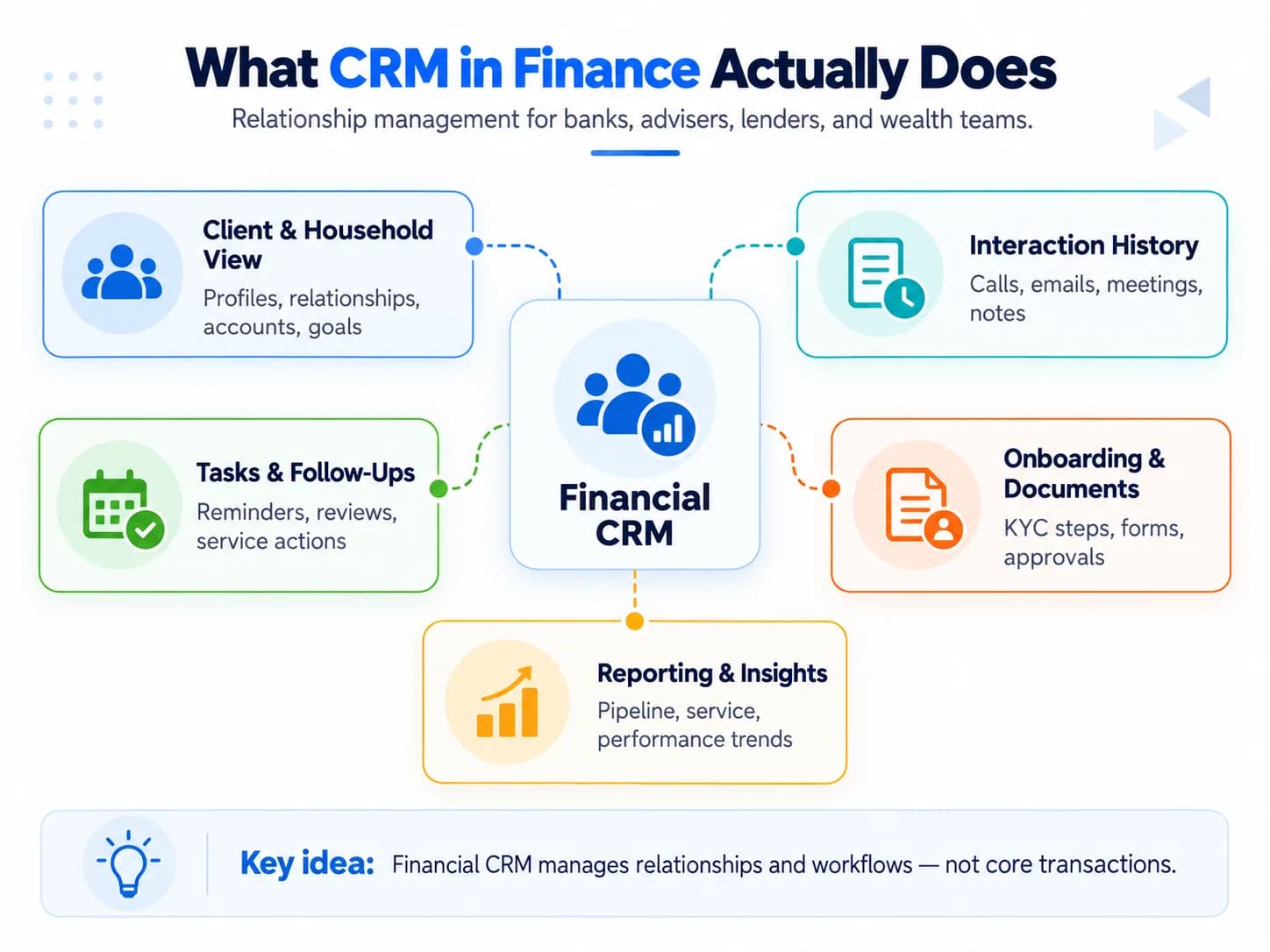
- CRM in finance manages relationships, not transactions: Financial CRM centralizes client, household, account, communication, and workflow data so banks, advisers, lenders, and wealth firms can manage relationships consistently alongside their core financial systems.
- Finance-specific workflows make CRM more valuable: The most important use cases include client onboarding, KYC coordination, lead and referral tracking, reviews, service requests, follow-ups, communication history, and identifying relevant relationship opportunities.
- The right features connect data to action: Useful financial CRM capabilities include Client 360 profiles, interaction capture, task automation, document workflows, permissions, audit trails, financial-system integrations, segmentation, and reporting that turn client information into coordinated next steps.
- Benefits depend on adoption and integration: CRM can reduce manual work, missed follow-ups, fragmented service, and poor visibility, but clunky interfaces, weak integrations, duplicate data, or excessive manual entry can prevent teams from realizing those benefits.
- CRM supports compliance but does not guarantee it: Financial CRM can help maintain records, permissions, documents, communication history, and audit trails, yet regulatory compliance still depends on applicable rules, system configuration, internal controls, supervision, and employee behavior.
How Is Financial CRM Different From a General CRM?
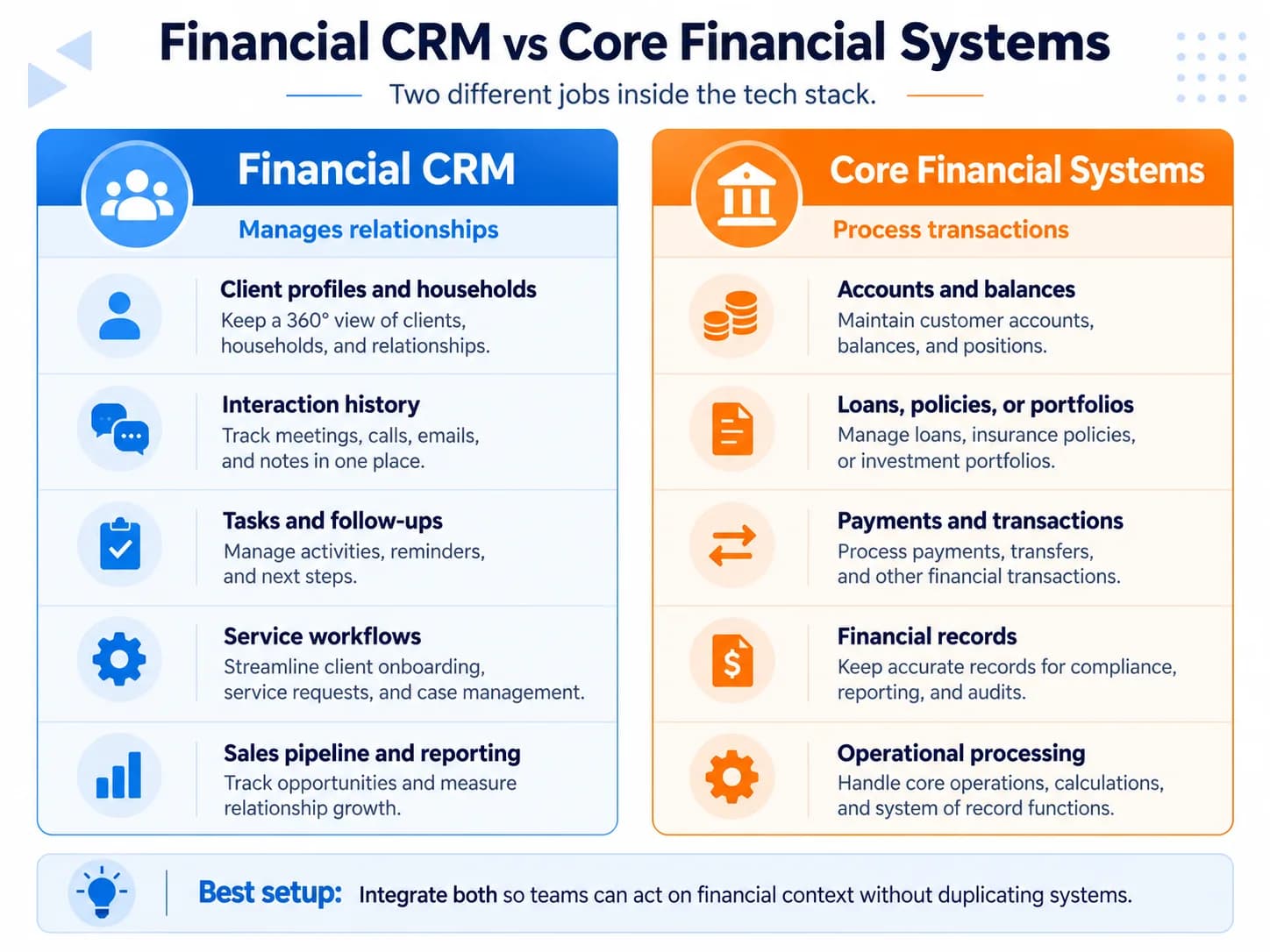
A general CRM may be sufficient for storing contacts, tracking deals and scheduling follow-ups. A financial CRM must usually handle a more complex relationship model.
Instead of recording only a person and a sales opportunity, it may need to connect:
- clients and household members;
- accounts or products;
- financial goals and relevant client circumstances;
- communications and meeting history;
- documents and onboarding status;
- tasks, reviews and service requests;
- advisers, bankers or relationship managers responsible for the account.
It also needs to exchange information with the financial systems the organization already uses.
This does not mean the CRM should replace core banking, portfolio-management, accounting or financial-planning software. Its main role is to provide the relationship and workflow layer that turns information from those systems into coordinated client-facing activity.
That distinction matters. Research into CRM in financial services has long warned against treating CRM as an isolated front-office database; effective CRM depends on integrating relationship activity with the broader organization and its processes.
In my experience, a general CRM can handle basic customer records and follow-ups, but financial services usually need workflows tailored to their specific processes. I have found that industry-specific customization, integrations, document handling, and controlled access to customer data become much more important in finance. A CRM delivers more value when it fits the actual business workflow instead of functioning as an expensive contact database.
Key CRM Use Cases in Finance
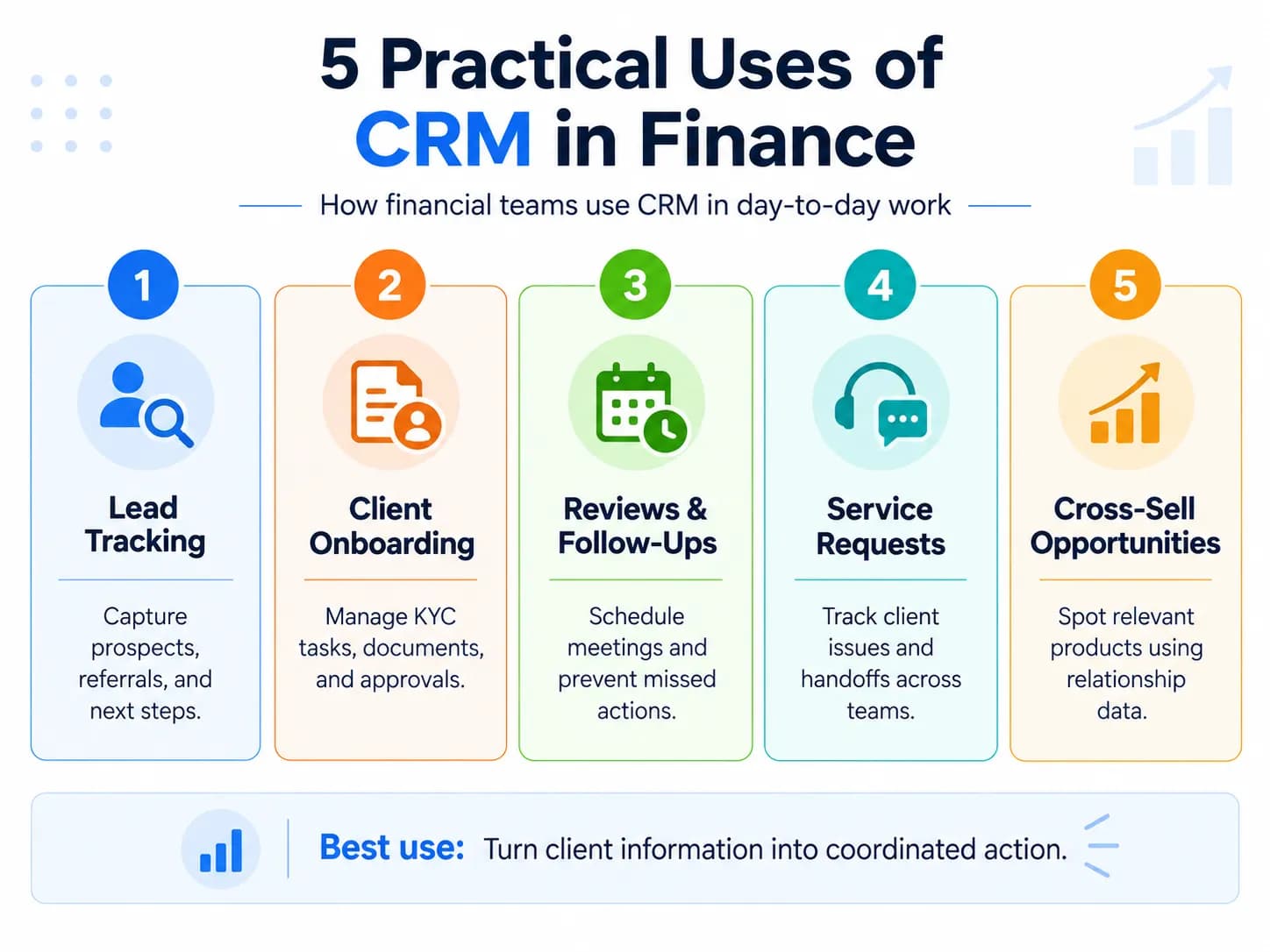
In my experience, the most practical CRM use cases are keeping client information centralized, tracking every interaction, scheduling follow-ups, and making sure important opportunities are not forgotten. I have also seen how reminders and automation reduce the burden of manually remembering what needs to happen next. The real benefit comes from designing these workflows around a clear business process rather than simply installing CRM software.
1. Build a Complete Client and Household View
Financial relationships rarely fit neatly into a single contact record.
A CRM can bring together contact details, relationships, accounts, products, communication history, documents, goals and important events into one client view. For advisers and wealth managers, this may also mean understanding connections between spouses, dependents, beneficiaries or other household members.
The practical benefit is context. Instead of reconstructing a relationship from emails, notes and separate systems before every conversation, staff can see who the client is, what has happened previously and which actions are outstanding.
Customer 360 is consequently one of the most consistent capabilities across current financial CRM platforms.
2. Manage Leads, Referrals and Opportunities
CRM also manages the journey before someone becomes a client.
Financial teams can record the source of a lead or referral, assign responsibility, track conversations, schedule the next action and monitor where each opportunity sits in the pipeline.
The important part is not simply creating another sales funnel. CRM preserves relationship history throughout the process, so a prospect does not become disconnected from the conversations, introductions and requirements that brought them to the firm.
It can also help managers identify stalled opportunities and ensure important follow-ups are not dependent on an individual employee's memory.
3. Coordinate Client Onboarding and KYC Workflows
Opening a financial relationship often requires more than completing a contact form.
Depending on the institution and jurisdiction, onboarding may involve identity information, documentation, verification, disclosures, approvals and other checks. A CRM can coordinate those steps by assigning tasks, recording status, collecting documents and showing where an application is waiting.
Zoho, Salesforce and other current financial CRM platforms explicitly position digital onboarding and identity-related workflows as financial-services functions.
For U.S. banks, for example, FinCEN's Customer Identification Program requirements require risk-based procedures for verifying customer identity. A CRM can help orchestrate such a process, although the institution remains responsible for designing and operating a compliant program.
4. Manage Client Reviews, Service Requests and Follow-Ups
A large part of financial relationship management happens after the initial sale.
CRM workflows can create reminders for scheduled reviews, assign follow-up tasks after meetings, track service requests and preserve notes from previous interactions.
For example, after an annual client review, the CRM could:
- store the meeting notes;
- assign follow-up actions;
- update relevant client circumstances;
- schedule the next review;
- preserve the resulting communication history.
This is one of the areas where usability matters most. In financial-adviser discussions, reminders, interaction tracking and follow-up management repeatedly appear among the practical requirements users care about most.
5. Personalize Client Service and Identify Relevant Opportunities
Financial CRM can combine relationship information with segmentation or behavioral information to make outreach more relevant.
A bank might identify customers whose existing activity indicates a potential need for another product. An adviser could use life-stage or client-goal information to trigger a review. A relationship manager could segment clients by service requirements rather than sending the same communication to everyone.
Salesforce and Zoho both illustrate this type of client-context-driven personalization and cross-selling in current financial CRM material.
The objective should be relevant service rather than simply generating more sales messages.
6. Maintain Communication and Compliance Records
Financial firms often need reliable records of communications and client activity.
A CRM can help by capturing interactions, maintaining timestamps, preserving documents, recording approvals and providing an audit trail of actions.
That support is meaningful. In August 2024, the U.S. Securities and Exchange Commission announced $392.75 million in combined penalties against 26 broker-dealers and investment advisers for failures to maintain and preserve required electronic communications.
A CRM does not, however, automatically make an organization compliant. Record-retention periods, supervisory controls, approved communication channels, permissions and other requirements depend on the institution, jurisdiction and applicable rules.
Essential Features of CRM for Financial Services
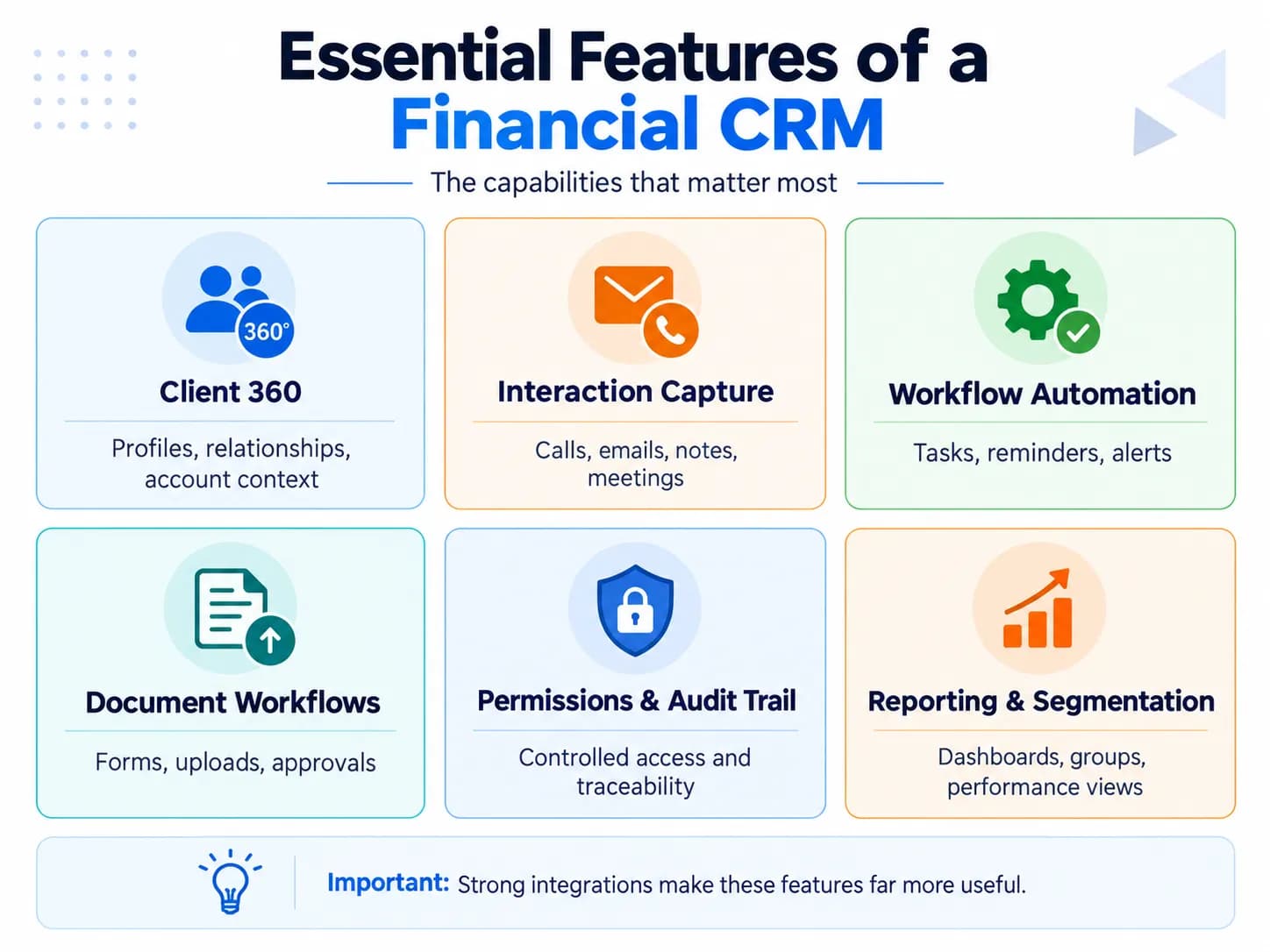
| Feature | What It Does | Why It Matters in Finance |
|---|---|---|
| Client and household profiles | Connects people, relationships, accounts, products and important client information | Financial relationships often extend beyond one person or one transaction |
| Interaction capture | Records calls, emails, meetings, notes and other touchpoints | Preserves relationship history and reduces reliance on employee memory |
| Workflow and task automation | Creates reminders, assignments and actions when events occur | Helps manage reviews, follow-ups, onboarding and service requests consistently |
| Onboarding and document workflows | Coordinates forms, documents, approvals and verification stages | Financial onboarding commonly involves multiple controlled steps |
| Permissions and audit trails | Controls access and records relevant actions | Financial firms handle sensitive client information and regulated activities |
| Financial-system integrations | Exchanges information with planning, banking, portfolio, accounting and other systems | Prevents staff from repeatedly switching systems or entering the same information |
| Segmentation and personalization | Groups clients using relevant attributes or behaviors | Helps teams provide more appropriate communication and service |
| Analytics and reporting | Shows pipeline activity, client behavior, service work and team performance | Gives managers visibility into relationships and operational bottlenecks |
| AI-assisted workflows | Can summarize records, surface patterns or assist with routine work | Useful when it reduces administrative work without weakening control or accuracy |
The exact feature set should follow the institution's workflows rather than an arbitrary checklist. A lender, investment bank and independent adviser may all use CRM, but the information and actions each needs to manage are different.
From my experience, the most useful CRM features are centralized client records, interaction history, automated reminders, reporting, integrations, and customizable workflows. For financial services, I would also prioritize document management, user permissions, and controlled access to sensitive client information. Choosing features around real operational needs keeps the CRM practical and prevents teams from paying for functionality they rarely use.
Benefits of CRM in Finance
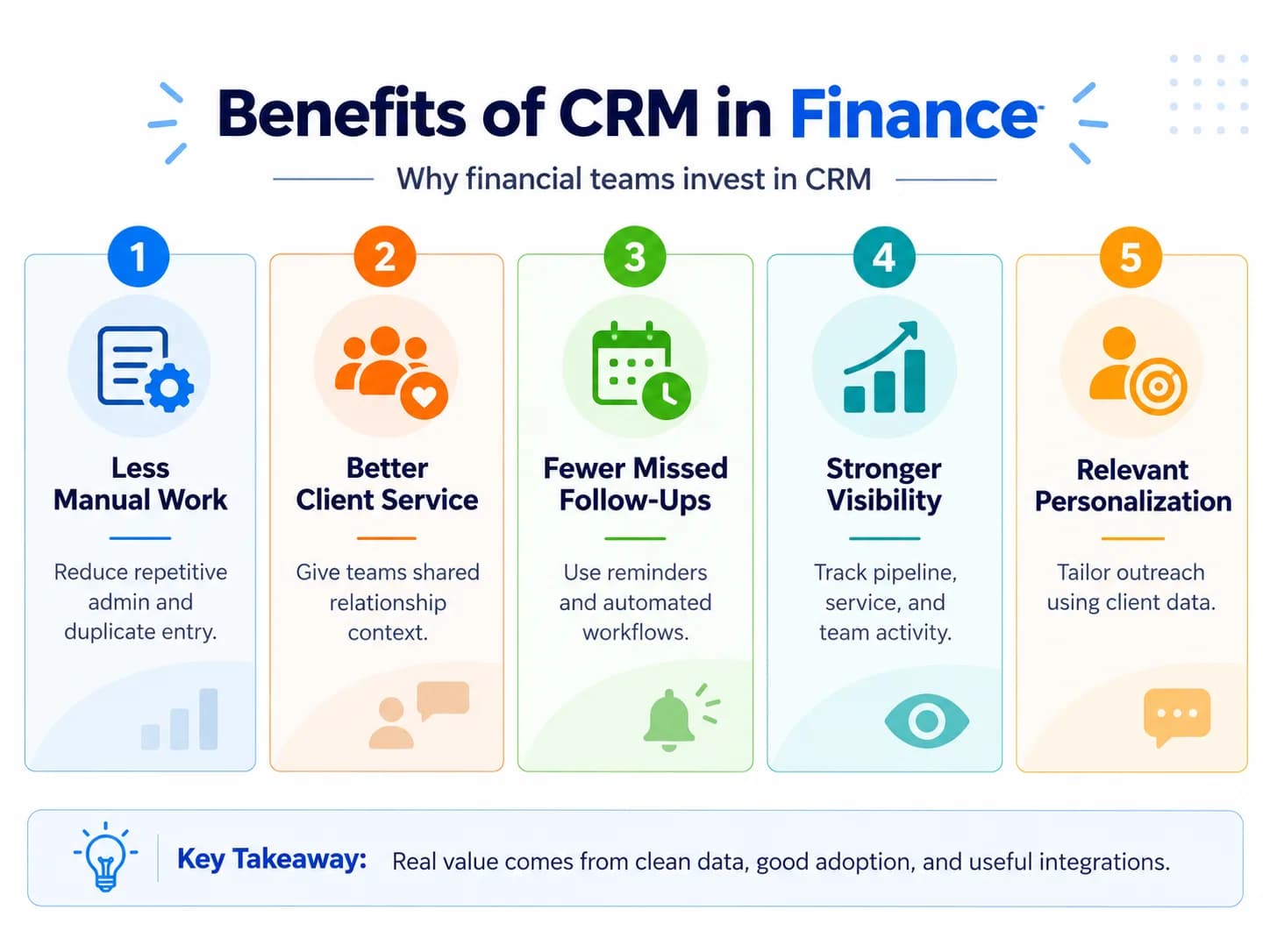
Less Manual Administrative Work
Automated capture, reminders and workflows can reduce repeated data entry and routine coordination.
That benefit depends heavily on integration. If staff still have to copy data manually between email, planning software, account systems and CRM, the organization has moved the silo rather than removed it.
More Consistent Client Service
A centralized interaction history helps employees understand what has already happened before they respond to a client.
It also improves continuity during handoffs. If a relationship manager is unavailable, another authorized employee can work from the same client context instead of asking the customer to repeat information.
Fewer Missed Follow-Ups
Tasks and event-based reminders turn follow-up from a memory-dependent activity into a managed workflow.
This applies to prospects as well as existing clients: inquiries, referrals, document requests, reviews and service cases can all have a defined next action.
Better Relationship and Opportunity Visibility
Managers can see pipeline activity, outstanding tasks and relationship status in one place.
Analytics can also identify patterns that are difficult to spot when client information is scattered across spreadsheets, email and specialist financial applications.
More Relevant Client Engagement
A well-maintained CRM allows communication to reflect the client's actual relationship with the institution.
That could mean using product holdings, goals, relationship history or service requirements to determine when a conversation is relevant rather than treating every customer identically.
Stronger Recordkeeping
Structured interaction history, documents and audit trails can make required information easier to retrieve and review.
For investment advisers subject to U.S. SEC requirements, the regulator specifically asks whether required information—including relevant electronic communications—is created, retained and capable of being produced when required.
Again, CRM is an enabling system rather than a substitute for a compliance program.
What a Financial CRM Cannot Do by Itself?
CRM creates value only when the surrounding processes work.
First, software cannot guarantee compliance. Rules vary by institution, activity and jurisdiction, and the CRM must be configured within appropriate policies and controls.
Second, CRM cannot fix poor-quality data automatically. Duplicate clients, outdated records and inconsistent account structures reduce the usefulness of automation and analytics.
Third, CRM should not become an unnecessary second copy of every financial system. Transaction processing, portfolio accounting, core banking and other specialist functions normally belong in their authoritative systems; CRM should surface the information employees need for relationship management and coordinate the actions around it.
Finally, employees have to use it. Community discussions among financial advisers repeatedly describe clunky interfaces, excessive manual entry and weak integrations as major sources of CRM frustration.
That leads to a useful evaluation principle:
The best financial CRM workflow is not the one with the most features. It is the one that captures the information the organization actually needs while making the next client action easier to complete and easier to document.
Frequently Asked Questions
What does CRM stand for in finance?
CRM stands for customer relationship management. In finance, it refers to software and workflows used to organize client information, record interactions, manage follow-ups, coordinate service processes, and maintain a consistent view of each customer or client relationship.
How is CRM used in banking?
Banks use CRM to centralize customer information, track interactions, manage leads and referrals, coordinate onboarding, handle service requests, schedule follow-ups, and identify relevant product opportunities. The CRM usually works alongside core banking systems rather than processing accounts or transactions itself.
Do financial advisors need a finance-specific CRM?
Not always. A general CRM can work if it supports the firm's workflows, security requirements and integrations, but finance-specific systems often handle household relationships, client reviews, financial-planning data and adviser workflows more naturally. Adviser discussions repeatedly show that usability and integration with existing tools often matter more than having the longest feature list.
Can a financial CRM help with regulatory compliance?
Yes, a financial CRM can support compliance through communication records, document retention, permissions, audit trails, workflow controls and required follow-ups. It does not make a firm compliant automatically; the organization still needs appropriate policies, configuration, supervision and recordkeeping procedures for the regulations that apply to it.
What systems should a financial CRM integrate with?
A financial CRM should connect with the systems employees use to manage the client relationship, such as email, calendars, financial-planning software, portfolio or reporting platforms, custodial systems, document management and e-signature tools. Strong integrations reduce duplicate entry and keep relationship data synchronized across the firm's technology stack.
Does a financial CRM replace core banking or financial-planning software?
No. Core banking, portfolio-management and financial-planning systems perform specialized financial functions, while CRM primarily manages client relationships, interactions and workflows. Integrating these systems allows the CRM to surface useful financial context without turning it into the authoritative system for transactions, portfolios or financial plans.