
Quick Summary
- CRM consulting connects business needs with effective CRM solutions: CRM consultants evaluate customer management processes, identify system problems, and recommend improvements. Their services typically include CRM audits, strategy development, platform selection, workflow optimization, data migration, integrations, and employee training—work that strengthens everyday customer relationship management.
- Hire a CRM consultant when internal expertise is insufficient: Professional consulting is particularly valuable when implementing or replacing a CRM, fixing unreliable reports, managing complex integrations, or improving inefficient workflows. A focused assessment can identify whether your existing system needs optimization rather than replacement—often the smarter path than a full CRM implementation rebuild.
- Not every CRM problem requires external consulting: Routine system updates, basic configuration, and simple reporting changes may be handled internally by a CRM system administrator. Before hiring, determine whether the issue involves technical limitations, unclear business processes, or poor employee adoption to avoid unnecessary consulting expenses.
- CRM consulting costs depend on expertise and project scope: Consultants may charge hourly rates, fixed project fees, or ongoing retainers. Compare proposals based on included deliverables, technical complexity, training, documentation, and post-project support rather than choosing the lowest quoted price—especially when CRM development or custom CRM development may be needed later.
- Choose consultants based on proven expertise and clear deliverables: Verify relevant platform experience, request comparable project examples, and confirm who will perform the work. Require a documented scope, measurable acceptance criteria, knowledge transfer, and clear system ownership to avoid costly mistakes and long-term consultant dependence that slows business growth.
What Is CRM Consulting?
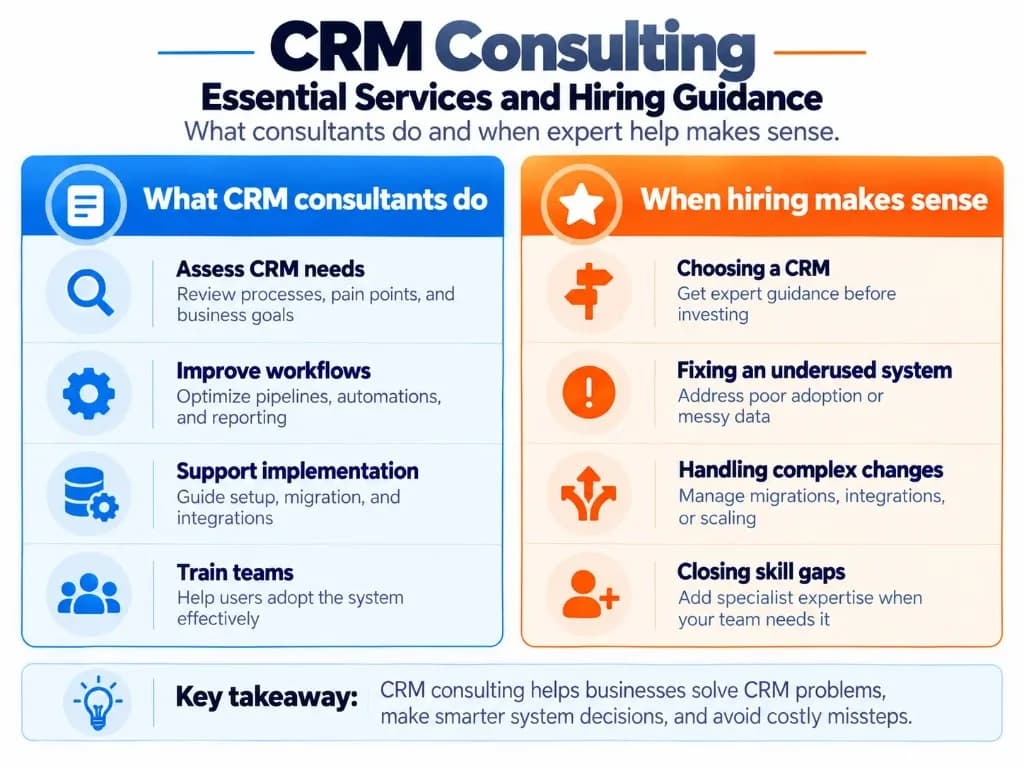
CRM consulting is the process of evaluating a business's customer relationship management needs and providing expert guidance on CRM software, processes, configuration, and performance.
A CRM consultant connects business requirements with practical technology decisions. Rather than simply installing software, the consultant identifies what the business needs its CRM to accomplish and how to make that happen—whether that means cleaner CRM data management, better lead management, or more reliable CRM metrics.
For example, a company might have a CRM but still struggle to track leads across its sales team. A consultant could investigate the existing process, identify why leads are being missed, and recommend workflow changes, sales automation, or configuration improvements that raise CRM system proficiency.
Some consultants focus on strategy and recommendations, while others also perform technical implementation, CRM integration work, and training after teams learn how to connect a CRM to marketing or support tools.
The distinction matters: CRM consulting determines what needs to change and why; implementation puts the agreed solution into practice. One provider may handle both.
What Does a CRM Consultant Do?
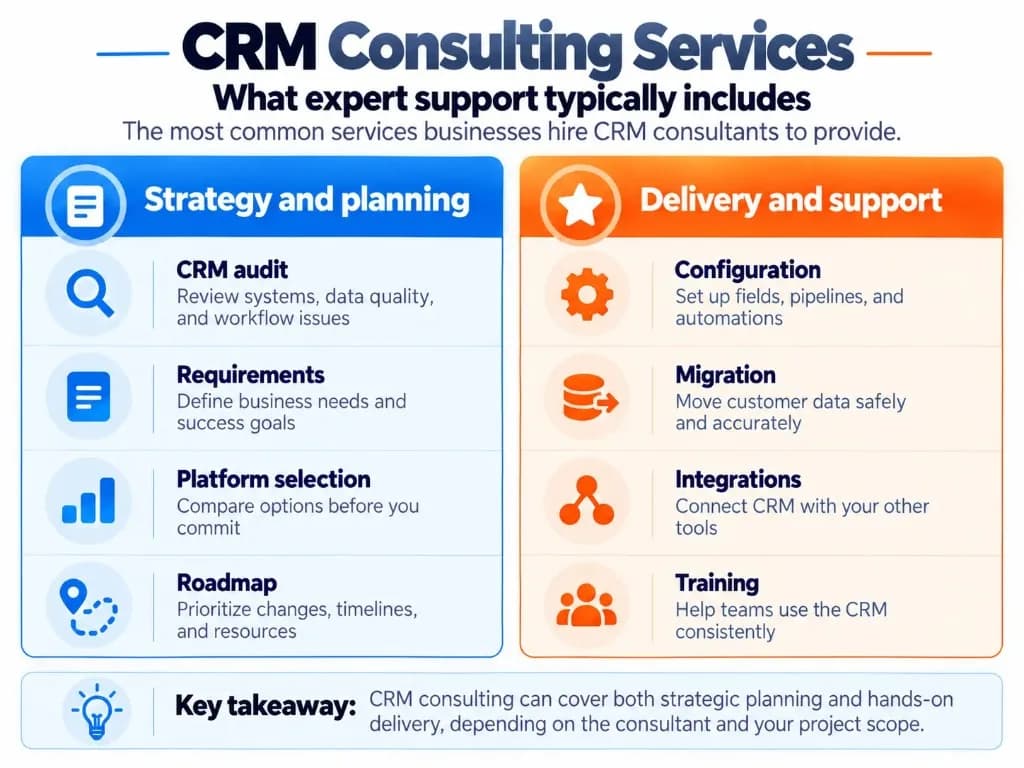
A CRM consultant evaluates business needs, identifies system problems, designs improvements, and helps teams use their CRM effectively. The exact responsibilities depend on the project and the consultant's expertise.
Typical CRM consulting services include:
| Service | What the consultant does | Typical deliverable |
|---|---|---|
| CRM audit | Reviews existing workflows, data quality, configuration, and user problems | Findings and prioritized recommendations |
| CRM strategy and requirements | Defines business objectives and translates them into system requirements | Requirements document and project roadmap |
| Platform selection | Evaluates CRM options against business needs, budget, and technical constraints | Vendor shortlist and selection rationale |
| CRM configuration and optimization | Improves pipelines, permissions, fields, automation, and reporting | Updated system configuration |
| Data migration and integration | Plans or executes data transfers and connections between systems | Validated data migration or working integrations |
| Training and adoption | Helps employees understand and use agreed workflows | Training materials, documentation, and adoption support |
A consultant may provide all these services or specialize in one area. A strategy-focused consultant, for example, may recommend an integration architecture without writing the integration code—leaving deeper CRM development or custom CRM development to specialists when standard tools fall short.
The important question is not how many services a consultant advertises. It is whether their expertise addresses your specific business problem, from CRM for digital marketing handoffs to B2B CRM pipeline redesign.
When Should You Hire a CRM Consultant?

Hiring a CRM consultant makes sense when a CRM-related problem is important to the business and the internal team lacks the time, expertise, or independent perspective needed to resolve it.
1. You are selecting or replacing a CRM
Choosing a system without clear requirements can leave a business paying for features it does not need or struggling with important limitations.
A consultant can document requirements, compare suitable options—including cloud-based CRM platforms—and identify migration or integration risks before the purchase.
Best fit: A CRM selection and requirements assessment that sets up a cleaner CRM implementation later.
2. Your existing CRM is not working as expected
Unreliable reports, duplicate records, missed follow-ups, or complicated workflows may indicate configuration or process problems rooted in CRM data entry quality and CRM data management gaps.
A consultant can investigate the causes before recommending changes. In some cases, improving the existing system is more practical than replacing it.
Best fit: A focused CRM audit and optimization plan.
3. You need a complex migration or integration
Moving customer records between platforms or connecting a CRM with accounting, marketing, or operational systems can create problems if data ownership, mapping, and validation are unclear—especially when marketing automation and sales automation write into the same CRM database.
A qualified specialist can assess dependencies, plan testing, and reduce avoidable disruption when you learn how to connect a CRM carefully.
Best fit: A technical CRM consultant or implementation partner with relevant CRM integration experience.
4. Your CRM no longer supports how the business operates
A CRM built for a small sales team may become difficult to manage as new teams, locations, workflows, or reporting needs emerge—including CRM for inside sales growth or service handoffs that need stronger contact management.
Consulting can help redesign the relevant processes and determine what changes are necessary without automatically adding more software.
Best fit: A CRM strategy and process-design engagement.
5. You lack specialist knowledge for an important project
Your internal team may understand the business but lack experience with a particular CRM platform, integration, or technical requirement.
External expertise can fill that temporary gap without requiring a permanent specialist hire, while still planning knowledge transfer so your CRM system administrator can own the system afterward.
Best fit: A defined advisory or technical engagement with knowledge transfer.
Match the problem to the right consulting service
| Business situation | Recommended first step |
|---|---|
| Reports contain inconsistent numbers | CRM data and reporting audit |
| A new CRM must replace an old system | Migration and implementation assessment |
| Leads are not assigned consistently | Sales workflow and automation review |
| Several systems contain conflicting customer records | Data ownership and integration assessment |
| Employees avoid using the CRM | Diagnose usability, training, and management expectations |
| The current system works and needs only routine updates | Internal CRM administration |
The goal is to buy the smallest engagement that can reliably solve the problem, rather than committing to a complete CRM rebuild without a diagnosis—especially when operational CRM process fixes can restore trustworthy CRM metrics.
When You May Not Need a CRM Consultant?
External consulting is not always the most effective solution.
You may not need a consultant if your CRM is functioning adequately and your team only needs routine updates, user administration, or basic reporting changes that a CRM system administrator can handle.
Consulting may also be premature when:
- Business processes are undefined. Leadership must first agree on how teams should handle customers and who owns each process. A consultant can facilitate this work but cannot make organizational decisions on leadership's behalf.
- Employees lack accountability. Technical improvements alone will not solve problems caused by unclear expectations, incentives, or management practices—or by vague CRM notes that hide outcomes.
- The problem is small and well understood. Existing administrators, vendor support, or available training resources may be sufficient.
- There is no internal project owner. Someone inside the business must approve decisions, coordinate stakeholders, and maintain the system afterward.
If the cause of a problem is uncertain, a limited diagnostic engagement may be more appropriate than hiring a consultant for a large CRM implementation.
CRM Consultant vs. CRM Administrator vs. Implementation Partner
These roles overlap, but their main responsibilities differ. Role clarity matters as much as product comparisons such as CRM vs CXM or CMS vs CRM differences.
| Role | Primary responsibility | When to use |
|---|---|---|
| CRM consultant | Diagnoses needs, recommends solutions, and may supervise or deliver changes | Strategic, process, or specialist challenges |
| CRM administrator | Maintains configuration, users, permissions, and everyday system operations | Ongoing CRM management |
| CRM implementation partner | Delivers a defined setup, migration, integration, or rollout | New deployments or substantial technical changes |
| CRM developer | Builds custom functionality or technical integrations | Requirements that standard configuration cannot meet |
A consulting firm may employ administrators, developers, and implementation specialists. An independent consultant may also perform several of these roles.
The difference is therefore about the work being contracted, not the provider's job title.
For routine system maintenance, an administrator may be enough. For an unclear business problem, consulting is more appropriate. For a clearly defined technical build, an implementation specialist—or targeted CRM development / custom CRM development—may offer better value.
What Happens During a CRM Consulting Engagement?
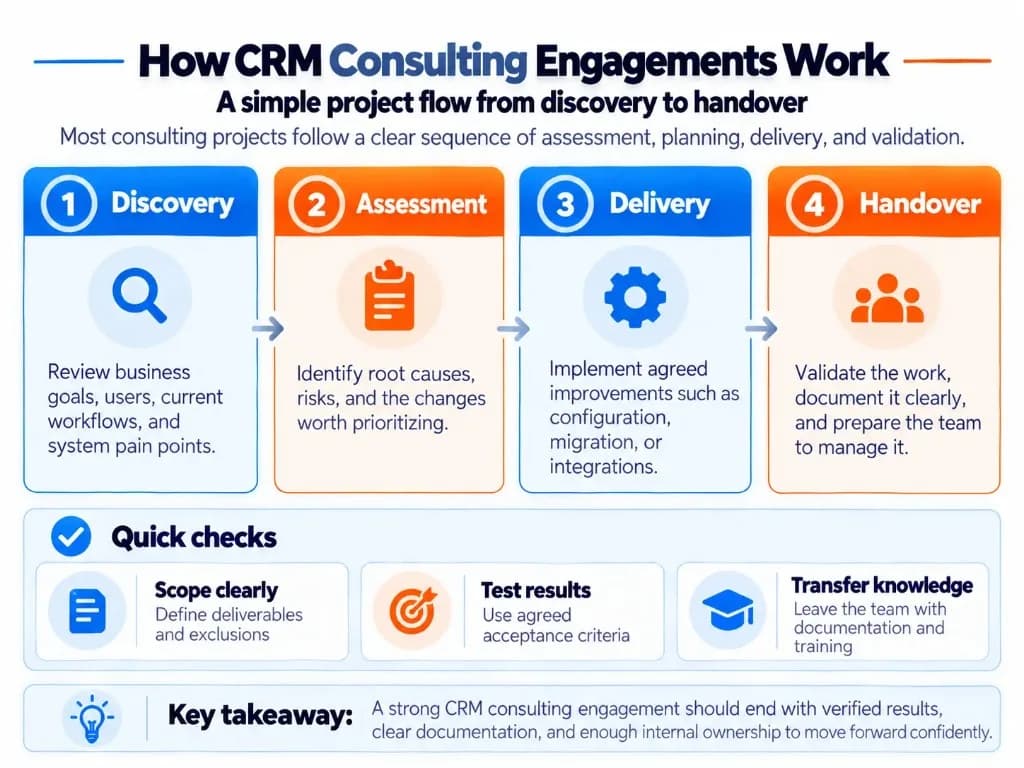
A well-scoped consulting engagement normally begins with understanding the problem and ends with documented recommendations or an accepted solution that your team can maintain with solid CRM system proficiency.
The process usually involves:
- Discovery: Review the business problem, interview relevant employees, and examine existing workflows and system limitations.
- Assessment: Identify root causes, technical dependencies, risks, and possible improvements.
- Recommendations and scope: Agree on priorities, deliverables, responsibilities, costs, and success criteria.
- Execution, if contracted: Configure the CRM, coordinate integrations, support migration, or oversee implementation.
- Validation: Test the agreed workflows and confirm that acceptance criteria have been met.
- Handover: Provide documentation, training, outstanding-issue records, and the information needed for internal ownership.
Not every engagement includes execution. A diagnostic project may legitimately end with a requirements document and prioritized recommendations—useful before a full CRM implementation budget is approved.
Example: Fixing a CRM with unreliable sales reports
Consider a business where sales managers cannot trust pipeline reports and CRM metrics conflict week to week.
The initial assumption might be that the CRM needs replacing. A consultant discovers instead that sales representatives use inconsistent deal stages, mandatory CRM data entry is missing, and several reports apply different filters.
Rather than recommending a new platform, the consultant could standardize pipeline definitions, adjust data-entry requirements, correct reports, and train the team on the revised process—including clearer CRM notes standards for deal updates.
The engagement would be successful if the agreed reporting tests pass and the internal team can maintain the changes.
This is an illustrative scenario, not a claimed client case study.
The example demonstrates why diagnosis should come before major technology decisions for B2B CRM and CRM for inside sales teams alike.
How Much Does CRM Consulting Cost?
CRM consulting costs depend on the provider's location, expertise, platform, scope, project complexity, and pricing arrangement.
According to Clutch's CRM consulting directory, advertised hourly rates span from under $25 to more than $300, with specialized senior consultants generally costing more than routine configuration support.
Clutch's US-focused directory also describes approximately 100–225 per hour as a common range for US-based CRM consulting firms. These are directory-based estimates, not standardized prices or guaranteed quotes.
Common pricing models
Pricing model
How it works
Best suited for
Hourly
Payment for time spent
Troubleshooting, advice, small changes
Fixed project fee
Agreed price for defined deliverables
Audits, assessments, bounded implementations
Retainer
Recurring payment for agreed support or capacity
Ongoing advisory and optimization
Milestone-based
Payment linked to accepted project stages
Larger projects with clear checkpoints
For a fixed-price engagement, compare what is included rather than looking only at the total—especially when CRM integration testing, training, and documentation are easy to under-scope.
One proposal might include discovery, configuration, migration testing, staff training, and post-launch assistance. A cheaper quote might exclude several of these activities.
Also account for CRM licensing, third-party tools, internal employee time, and ongoing maintenance on a cloud-based CRM. These costs may sit outside the consultant's fee.
Before agreeing to a project, request a written scope, payment terms, assumptions, exclusions, and a process for approving additional work that could expand into CRM development.
How to Choose the Right CRM Consultant?

The best CRM consultant is not necessarily the largest agency or the person with the most certifications. It is the provider whose proven experience, proposed approach, and delivery model match your problem and support sustainable business growth.
1. Look for relevant project experience
Ask for examples of projects involving comparable workflows, technical complexity, or business requirements—such as CRM for digital marketing attribution, data cleanup, or multi-team contact management.
A consultant experienced in setting up basic sales pipelines may not be the right choice for a complicated enterprise migration.
Look for explanations of the original problem, the work performed, the outcome, and any limitations.
2. Verify platform expertise
When the project involves a particular CRM, verify that the consultant has relevant hands-on experience.
Official directories can help. Salesforce Partner Finder allows customers to research consulting partners, while the HubSpot Solutions Directory provides service, industry, and partner information.
However, partner status or certification should support your assessment, not replace references, a credible delivery plan, or evidence of similar work.
3. Evaluate the discovery process
A capable consultant should ask about your business goals, users, current processes, system limitations, data, and constraints before proposing a solution—including how you currently approach CRM data management and how to connect a CRM to other tools.
Be cautious of a provider who recommends replacing the CRM, buying additional licenses, or purchasing extensive customization without investigating the underlying problem.
4. Meet the person responsible for delivery
The person conducting the sales presentation may not be the person performing the work.
Ask who will lead discovery, who will handle technical decisions, whether subcontractors will be involved, and how issues will be escalated—especially if custom CRM development may be required.
5. Review the contract and handover requirements
A useful statement of work should identify the specific outputs you are purchasing.
Before signing, establish:
- The problem, objectives, and agreed deliverables.
- The work included and explicitly excluded.
- Who makes business decisions and who approves technical changes.
- Project milestones, acceptance criteria, and payment terms.
- Documentation, training, and system ownership requirements.
- Support arrangements and how additional work will be approved.
- Data access, confidentiality, and security responsibilities.
CRM consultants may need access to sensitive customer information. The Federal Trade Commission's cybersecurity guidance recommends documenting vendor-security expectations and controlling how vendors access and handle business data.
Use appropriately limited access, retain administrative ownership for your CRM system administrator, and establish what happens to consultant access and retained data when the engagement ends.
6. Ask these questions before hiring
What do you believe is causing our problem, and how will you verify it?
Have you solved a similar problem using our CRM platform?
What will we receive at the end of the engagement?
Who will actually perform the work?
Which responsibilities remain with our internal team?
What is excluded from your quote?
How will you document and hand over the solution?
What support is available after completion?
Watch for warning signs: vague deliverables, unwillingness to provide relevant examples, pressure to buy software before discovery, unclear ownership of configurations, or a proposal that makes ongoing dependence on the consultant unavoidable.
An independent consultant may be suitable for a focused assessment or specialist task. A consulting firm may be more appropriate when the project requires several disciplines, coordinated delivery, and ongoing support—including marketing automation redesign or operational CRM process work.
Neither model is automatically better. Match the provider's capabilities and accountability to the scope.
How to Know Whether CRM Consulting Was Successful?
A successful engagement should produce more than a completed configuration or a set of recommendations. It should resolve the agreed problem and leave the business capable of using or maintaining the result with stronger CRM system proficiency.
Define success before work begins. Depending on the project, useful acceptance measures include:
| Project objective | Evidence of success |
|---|---|
| Improve reporting reliability | Agreed reports reconcile with validated source records |
| Fix lead management | Sample leads move through the required assignment and follow-up workflow |
| Migrate to another CRM | Required records transfer correctly and pass agreed validation tests |
| Improve workflow usability | Target users can complete representative tasks |
| Reduce consultant dependence | Internal staff receive working documentation, access, and training |
Technical acceptance and longer-term business improvement are not identical. A migration can pass its data tests before the business sees benefits from using the new system—or before CRM metrics stabilize.
For that reason, agree on both immediate deliverables and any later business measures that matter, such as report reliability, workflow completion, or user adoption.
The right CRM consulting engagement leaves you with a clear solution to a defined problem, verified results, and enough internal ownership to move forward without unnecessary outside dependence—supporting durable business growth.
Frequently Asked Questions
Is hiring a CRM consultant worth it for a small business?
Yes, CRM consulting can be worthwhile for small businesses facing persistent workflow problems, unreliable customer data, or complex software decisions. However, businesses with straightforward needs may only require basic CRM training, stronger CRM system proficiency, or a short consultation rather than a full CRM implementation project.
How long does a CRM consulting project take?
A focused CRM audit or assessment commonly takes two to four weeks, while implementation projects may take several weeks to several months. The timeline depends on system complexity, data migration, integrations, and the number of teams involved. Request a project schedule with defined milestones before hiring.
Can I hire a CRM consultant for a one-time audit?
Yes, many CRM consultants offer standalone audits without requiring a long-term contract or full implementation. A typical audit examines system configuration, CRM data management issues, workflows, and reporting problems. You should receive a documented assessment with prioritized recommendations that your internal team or another provider can implement.
What should I prepare before meeting a CRM consultant?
Prepare a short description of your business processes, current CRM platform, connected software, and the main problems you want to solve. Include specific examples of failed workflows, inaccurate CRM metrics, or CRM data entry gaps, along with two or three desired outcomes. You usually do not need to share sensitive customer records during the initial consultation.
Can a CRM consultant fix a failed implementation without replacing the entire system?
Yes, an experienced consultant can often recover a poorly implemented CRM by identifying configuration errors, repairing workflows, improving data quality, and simplifying unnecessary customizations. A technical audit should determine which components can be retained and which require rebuilding—sometimes with limited CRM development rather than a full rebuild. Replacing the platform should be considered only when the existing system cannot reasonably meet business requirements.
Can CRM consultants work remotely?
Yes, CRM consultants can perform many services remotely, including system audits, configuration, troubleshooting, workflow design, and employee training on cloud-based CRM platforms. They typically collaborate through video meetings and controlled access to your CRM. For complex projects, confirm time-zone availability, communication expectations, and whether on-site workshops are necessary.
Will I need ongoing CRM consulting after the project is completed?
Not necessarily. A properly documented CRM project should allow your internal CRM system administrator to handle routine administration and maintenance. You may still benefit from occasional consulting for major upgrades, complex CRM integration work, or new business requirements. Agree on post-project support options and knowledge-transfer responsibilities before the engagement ends.