
Quick Summary
- CRM manages relationships; CXM improves experiences: Customer Relationship Management (CRM) organises customer information, sales opportunities, communication history, and service interactions. Customer Experience Management (CXM) focuses on understanding customer perceptions, identifying friction, and improving experiences across the customer journey—the same customer relationship management foundation that CRM for service businesses rely on when they need both records and satisfaction.
- CRM and CXM differ in their goals, data, and metrics: CRM primarily tracks customer activities, sales pipelines, conversions, and relationship performance. CXM evaluates customer feedback, satisfaction, effort, and journey quality using measures such as CSAT, NPS, and CES. CRM metrics help with commercial performance; experience scores help with how those relationships feel.
- CRM and CXM work better together: CRM provides customer records and interaction history, while CXM helps identify problems affecting those interactions. Connecting both enables businesses to resolve individual issues, recognise recurring experience problems, and improve customer satisfaction through informed actions. Clean CRM data management keeps that connection usable.
- The right choice depends on your business needs: Prioritise CRM when managing leads, customer records, and follow-ups is the main challenge. Focus on CXM capabilities when customer dissatisfaction, inconsistent experiences, or journey friction require attention. Businesses managing both challenges can benefit from combining the approaches—the same practical test that guides CRM implementation decisions.
- You do not always need separate CRM and CXM software: Modern CRM platforms may already include feedback surveys, service automation, and experience analytics. Evaluate your existing capabilities before investing in another system, as disconnected platforms can increase costs, duplicate customer information, and complicate workflows. Strong user adoption matters more than unused tools.
What Are CRM and CXM?
What Is CRM?
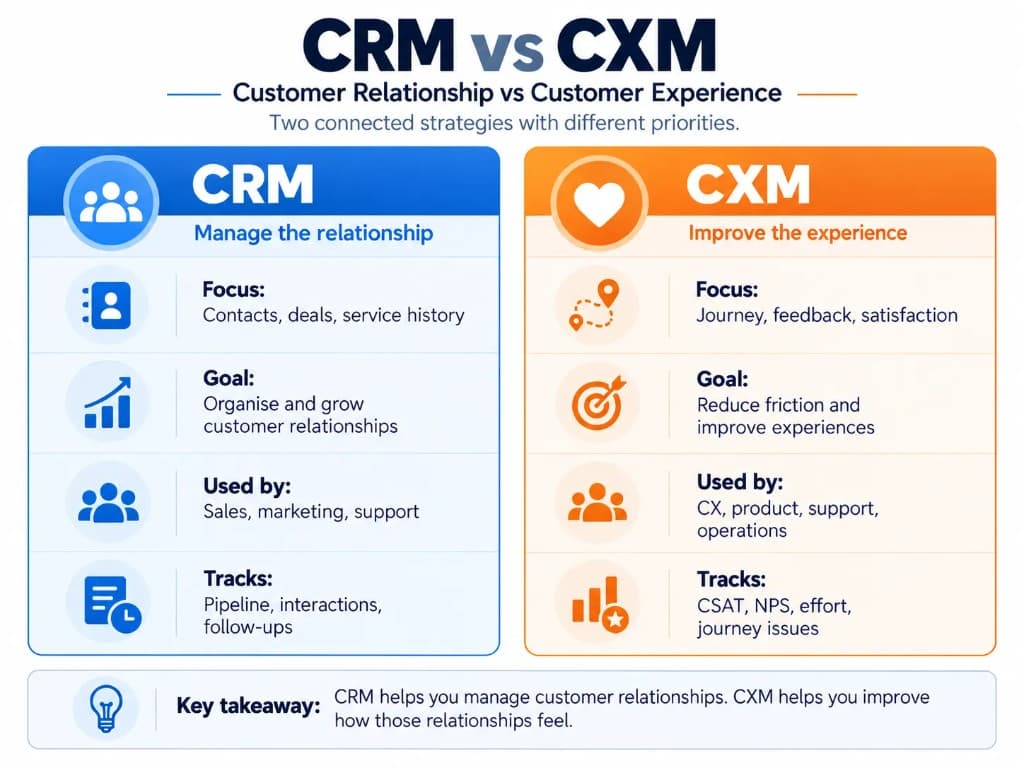
Customer Relationship Management (CRM) is a business strategy and category of software used to organise customer information, manage interactions, and coordinate sales, marketing, and service activities.
CRM systems typically maintain customer profiles, communication records, sales opportunities, purchase histories, and service cases inside a reliable CRM database. Teams use this information to manage relationships, follow up on enquiries, and make informed decisions about individual customers.
For example, a sales representative can use CRM to review a prospect's previous conversations, identify an open opportunity, and schedule the next follow-up. A clear sales pipeline keeps that commercial progress visible, while sales automation can help with reminders without replacing judgment.
What Is CXM?
Customer Experience Management (CXM) is the practice of understanding, measuring, and improving how customers experience a business throughout their journey.
CXM considers interactions across websites, sales conversations, purchasing, onboarding, customer support, and other touchpoints. It uses information such as customer feedback, behaviour, satisfaction scores, and service outcomes to identify friction and improve experiences—areas where CRM for call centers and ecommerce CRM teams often feel pressure first.
For example, a company can use CXM to identify why customers struggle during onboarding and change the process to reduce confusion and effort.
CXM is also called Customer Experience Management (CEM). Customer experience (CX) refers to the experience itself, while CXM refers to the processes and activities used to manage and improve it. For a terminology comparison with other relationship systems, see our guide to CMS vs CRM differences.
CRM vs CXM: Key Differences
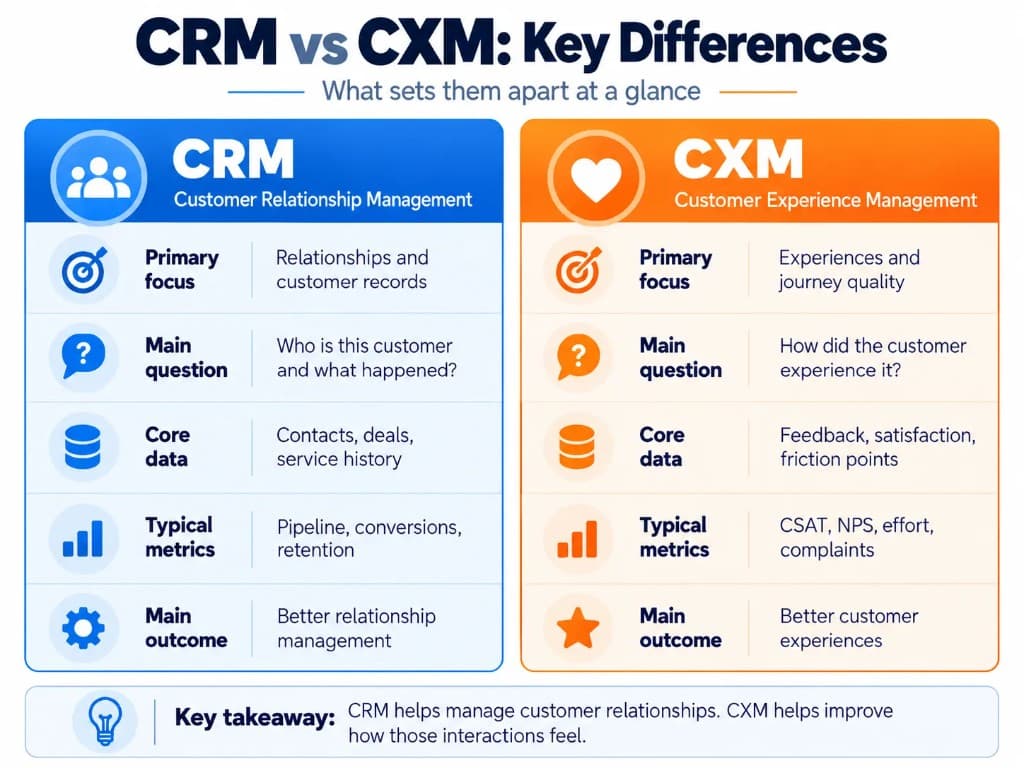
CRM and CXM differ primarily in their objectives, the information they prioritise, and how teams use their insights.
| Comparison | CRM | CXM |
|---|---|---|
| Primary focus | Managing customer relationships and interactions | Improving the quality of customer experiences |
| Perspective | How the business understands and manages customers | How customers experience the business |
| Main objective | Improve relationship management, operational efficiency, and commercial outcomes | Reduce friction, improve satisfaction, and strengthen experiences |
| Key information | Contact details, purchases, communication history, opportunities, and service records | Feedback, satisfaction, customer effort, behaviour, and journey problems |
| Typical capabilities | Contact management, pipeline tracking, sales automation, and case management | Feedback analysis, journey mapping, experience monitoring, and improvement workflows |
| Primary users | Sales, marketing, account management, and customer service teams | CX, customer service, product, marketing, and operations teams |
| Common metrics | Conversion rates, pipeline value, sales activity, and retention | CSAT, NPS, CES, complaints, and experience-related outcomes |
| Typical output | Organised customer records, relationship workflows, and follow-up actions | Experience insights, identified friction, and corrective actions |
These distinctions describe primary priorities, not exclusive features. CRM platforms can collect feedback and support experience-focused workflows, while CXM systems can use transactional data and customer profiles. Comparing CRM platforms only by feature labels usually hides that gap.
Customer Data vs Customer Experience Data
CRM data helps teams understand what customers have done and how the business has interacted with them. It might show that a customer purchased twice, contacted support, and has an upcoming renewal.
CXM uses customer, operational, and experience information to investigate how well those interactions worked for the customer. It might reveal that the same customer's support experience required excessive effort or that the renewal process created confusion.
CXM is not exclusively qualitative, and CRM is not exclusively quantitative. Both may use numerical measures, written feedback, behavioural information, and real-time signals. What separates them is the purpose for which the information is used—closer to operational CRM when the focus is day-to-day relationship work, and closer to experience improvement when the focus is how that work felt.
CRM Metrics vs CXM Metrics
CRM commonly tracks commercial and relationship performance, including lead conversion, deal progression, sales activity, and retention. CRM analytics still matter when revenue questions are the real bottleneck.
CXM places greater emphasis on experience measures, such as:
- Customer Satisfaction Score (CSAT): How satisfied customers are with a particular product, service, or interaction.
- Net Promoter Score (NPS): How likely customers are to recommend a company, used as an indicator of customer loyalty and advocacy.
- Customer Effort Score (CES): How much effort customers perceive they need to complete an interaction or resolve an issue.
These metrics are not mutually exclusive. Retention, repeat purchases, and customer lifetime value can matter to both disciplines. Experience scores are most useful when interpreted alongside operational and behavioural data rather than treated as proof that every customer problem has been resolved.
CRM vs CXM Example: A Delayed Customer Order
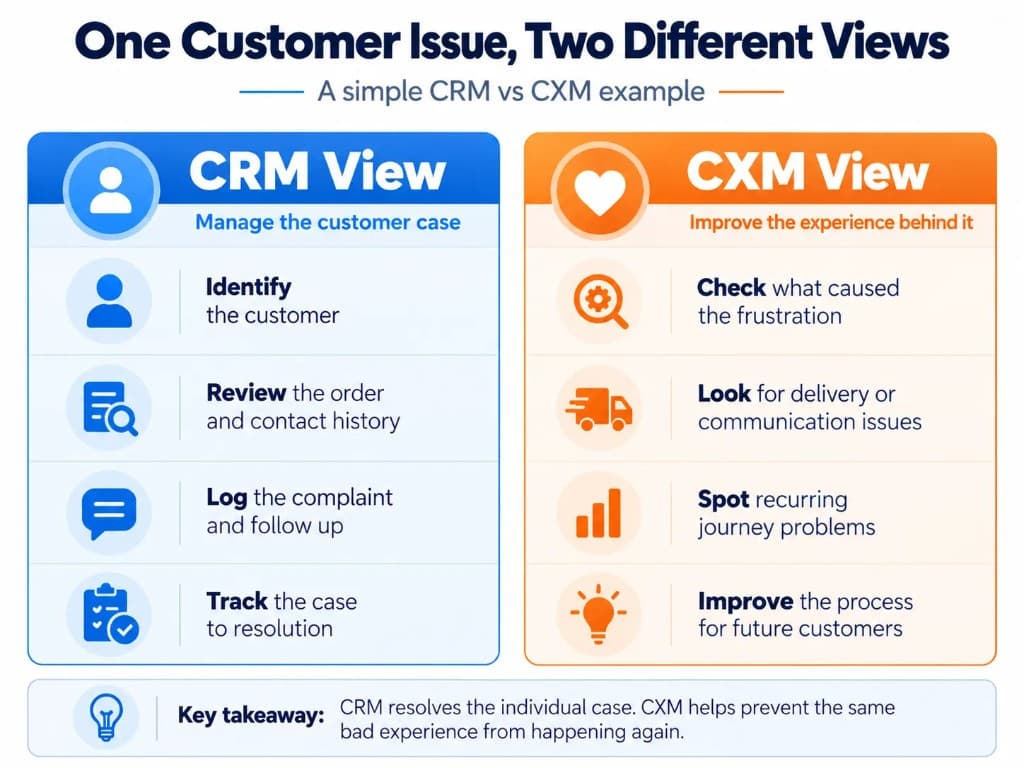
Consider an online retailer whose customer contacts support because an order has arrived late—a familiar scenario for CRM for retail and ecommerce CRM teams.
How CRM handles the situation
The company's CRM helps the service representative identify the customer, review the order, check earlier conversations, record the complaint, and schedule a follow-up.
The business has an organised record of what happened and the actions taken for that customer.
How CXM handles the situation
The company's CXM process examines the experience surrounding the delayed delivery.
Customer feedback and operational information might reveal that delivery estimates were unclear, tracking updates were inconsistent, or several customers encountered the same problem.
The business can then improve delivery communications, identify recurring friction, and evaluate whether subsequent customers have a better experience.
How they work together
CRM provides the customer and interaction context. CXM identifies what made the experience difficult and helps guide improvements.
The company can resolve the individual complaint while also addressing the underlying issue affecting other customers.
The distinction is important: recording a customer problem is not the same as preventing it from recurring. CRM vs project management software comparisons show a similar pattern—one system tracks the case, another helps improve the process around it.
How CRM and CXM Work Together
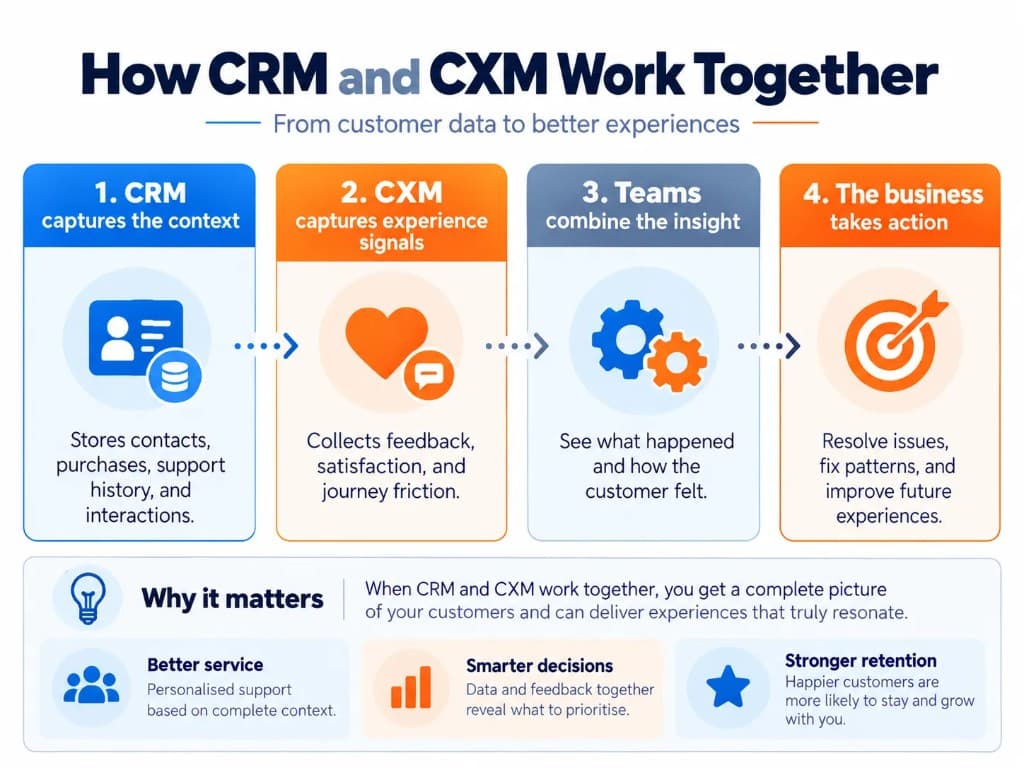
CRM and CXM are complementary approaches rather than competing alternatives.
A connected workflow can use information from both to understand customer needs and improve how the business responds.
Capture the relationship context. CRM records the customer's identity, relevant history, interactions, and service activity.
Collect experience signals. Surveys, support feedback, reviews, and customer behaviour reveal satisfaction or difficulties.
Connect and analyse the information. Teams relate experience signals to the relevant customers, transactions, and touchpoints to identify patterns and priorities.
Take action and evaluate the result. Responsible teams resolve individual issues, improve recurring problems, and monitor whether the changes help.
For example, CRM records might show that several customers stopped renewing after contacting support. Experience feedback could reveal a recurring onboarding or service problem that requires attention. B2B CRM and CRM in finance teams often see the same pattern when renewals stall after a poor service moment.
Connecting the information makes it easier to investigate the relationship between customer activity and dissatisfaction. Well-defined CRM integrations help prevent duplicate records and lost context during that handoff.
However, integrating systems does not automatically improve customer experience. Teams still need accurate information, clear ownership, and a process for acting on what they learn.
Should You Use CRM, CXM, or Both?
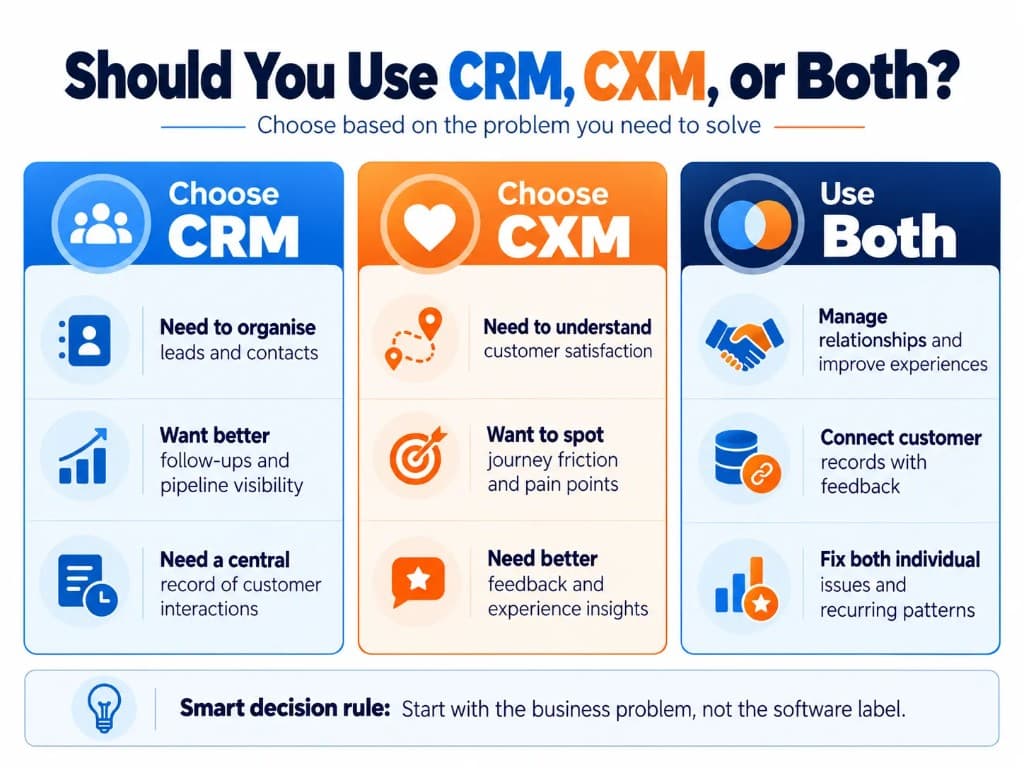
The right choice depends on the problem your business needs to solve, rather than the terminology used by software vendors.
Choose CRM First When Relationship Management Is the Main Problem
CRM should generally be the priority when your business needs to organise contact information, manage leads and sales opportunities, track conversations, or coordinate customer follow-ups.
For example, a small service business struggling with missed enquiries and inconsistent sales follow-ups may benefit more from improving its CRM processes than purchasing a separate experience-management platform. CRM for insurance agents and CRM for real estate face the same risk when relationship context is scattered across inboxes.
A well-configured CRM can also support basic feedback and customer service workflows—whether the product is a traditional suite or a cloud-based CRM.
Prioritise CXM Capabilities When Customer Experience Is the Main Problem
Additional CXM capabilities become valuable when the business has customer records but struggles to understand why customers are dissatisfied or where experiences are breaking down.
Common signals include recurring complaints, fragmented customer feedback, unclear causes of dissatisfaction, and inconsistent experiences between channels. Telecom CRM and CRM for government show a similar split: relationship systems do not automatically replace structured experience improvement.
The business may need better feedback analysis, journey visibility, cross-team coordination, or processes for responding to experience issues.
That does not automatically mean buying a separate CXM product. Existing software should be evaluated first. If off-the-shelf CRM tools force awkward experience workarounds, plan for custom CRM development only after the core relationship workflow is clear.
Use Both When You Need Connected Relationship and Experience Insights
Combining CRM and CXM capabilities is especially useful when a business must manage individual customer relationships while also improving recurring issues across the customer journey.
For example, a growing subscription business may need CRM to track accounts, renewals, and service history, while using CXM capabilities to investigate onboarding friction and satisfaction trends. Pharmaceutical CRM teams use a similar connection when compliance-sensitive interactions still need experience monitoring.
The goal is to connect customer context with experience insights so teams can take more relevant action.
Can One Platform Handle Both CRM and CXM?
Yes. CRM and CXM represent different management priorities, but they do not always require separate software platforms.
Modern CRM ecosystems may include service management, customer feedback surveys, automation, analytics, and other experience-related features.
For example, HubSpot's customer feedback tools can connect survey information with CRM records and follow-up workflows. Similarly, broader enterprise platforms may combine customer records with experience-management applications.
Before selecting another platform, evaluate whether your existing software can:
- Capture meaningful customer feedback and experience signals.
- Connect those signals to relevant customer records and interactions.
- Identify recurring problems across touchpoints.
- Trigger appropriate follow-up or corrective actions.
- Measure whether those changes improve customer outcomes.
A dedicated CXM platform may be worthwhile when existing tools cannot provide the required coverage, analysis, or coordination at a practical cost. CRM development depth also matters when configuration becomes the deciding factor.
The deciding factor is not whether software is labelled CRM or CXM. It is whether your business can manage customer relationships effectively while understanding and improving the experiences those relationships produce. The lightest setup that supports measurable business growth is usually better than the heaviest feature list.
Frequently Asked Questions
Can you use CXM without a CRM system?
Yes, a business can use Customer Experience Management (CXM) without dedicated CRM software. CXM activities such as collecting feedback, monitoring satisfaction, and identifying customer journey problems can operate independently. However, connecting CXM with CRM data provides additional context about customer interactions, purchases, and relationships, making experience insights more actionable. Spreadsheets sometimes fill that gap temporarily, but they rarely preserve relationship history well.
Why can't a CRM alone solve every customer experience problem?
A CRM can manage customer interactions and support service improvements, but it may not provide complete visibility into customer perceptions or recurring problems across every touchpoint. Experience management also requires analysing feedback, identifying friction, and coordinating improvements. A CRM with sufficient experience-management capabilities can support these activities without separate CXM software.
Is collecting customer feedback enough for effective CXM?
No. Collecting feedback is only one part of Customer Experience Management. Businesses must also analyse responses, identify recurring problems, assign responsibility, and implement improvements. Surveys and satisfaction scores provide useful signals, but their value depends on whether the organisation acts on those findings.
What customer information should CRM and CXM systems share?
CRM and CXM systems should share relevant customer identifiers, interaction histories, purchase or subscription information, support cases, and experience feedback. Connecting these records helps teams understand which customers encounter problems and how those issues affect their relationships. Appropriate access controls and consistent customer identification are essential to avoid inaccurate or unnecessary data sharing.
What are the disadvantages of using separate CRM and CXM platforms?
Separate platforms can increase software costs, integration requirements, and administrative work. Without reliable data synchronisation, teams may encounter duplicate records, inconsistent customer information, or disconnected feedback. Businesses should evaluate whether the benefits of specialised CXM capabilities justify the additional complexity compared with extending their existing CRM.
Can a small business improve customer experience without buying CXM software?
Yes. Small businesses can improve customer experience through structured feedback collection, consistent customer service, and timely resolution of recurring issues. Existing CRM tools, surveys, and support systems may provide enough functionality initially. Dedicated CXM software becomes more useful when feedback volume, customer journey complexity, or coordination requirements exceed what current tools can manage.