
Quick Summary
- Telecom CRM connects customer relationships with telecom services: It combines customer and account information with subscriptions, orders, billing context, support history, and service data so telecom teams can manage the customer lifecycle from acquisition through renewal—the same customer relationship management goal as CRM for service businesses or CRM for call centers, adapted to subscriptions and network services.
- It goes beyond a standard sales CRM: Telecom providers must track relationships such as customer → account → subscription → service → SIM, device, or number, while also handling recurring billing, activation, service changes, and complex multi-service accounts inside a reliable CRM database.
- CRM, BSS, and OSS have different roles: CRM manages customer-facing relationships and workflows, BSS supports commercial functions such as billing and orders, and OSS handles service and network operations. Telecom CRM usually connects these systems rather than replacing them. Clean CRM integrations keep that connection usable day to day.
- A unified customer view depends on strong integrations: Billing, provisioning, ordering, ticketing, and service-status data may come from separate platforms. The CRM brings relevant information together so sales and support teams can act without constantly switching systems.
- Integration and handoffs are common real-world weak points: Telecom and ISP operators frequently report problems when sales, billing, provisioning, and support tools do not synchronize reliably. A useful telecom CRM must therefore manage complete workflows, not just store customer records—comparing CRM platforms only by feature count usually hides that difference.
How Do Telecom Companies Use CRM to Manage Customers?
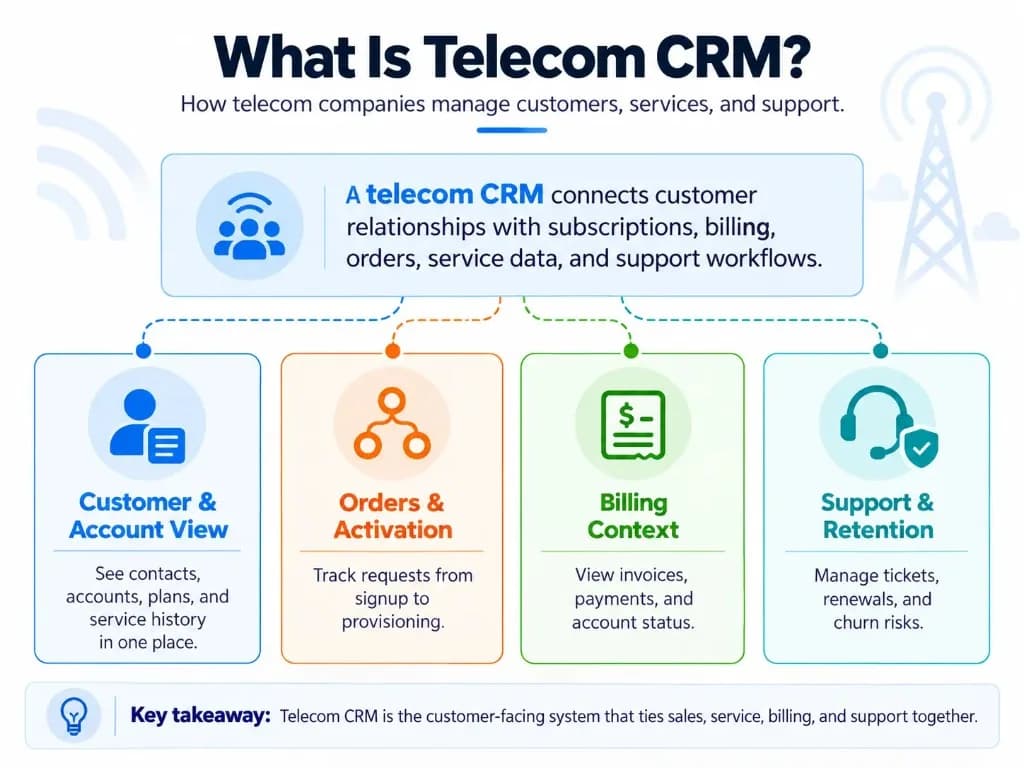
Telecom customer management continues well beyond the initial sale. A typical CRM-supported lifecycle looks like this:
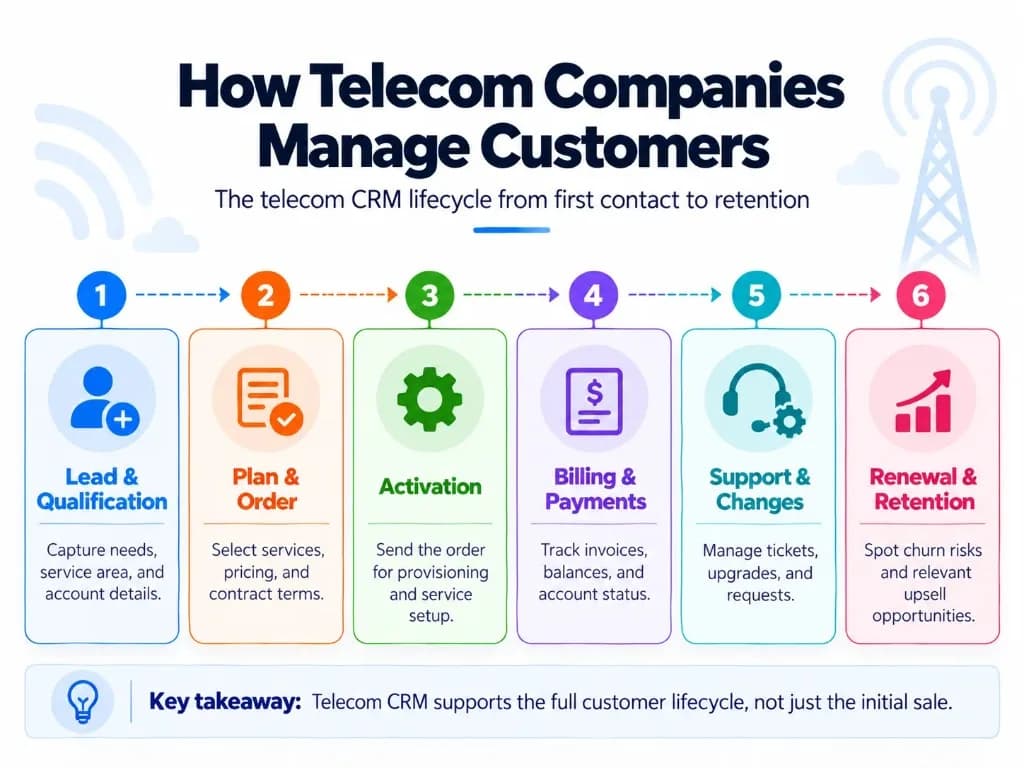
| Customer stage | What the CRM helps manage |
|---|---|
| 1. Lead and qualification | Contact details, requirements, location, service eligibility, business/consumer account information and sales activity |
| 2. Plan, quote and order | Selected services, plans, devices, contract terms, pricing and orders |
| 3. Activation and provisioning | Handoff to systems responsible for creating or activating the ordered service |
| 4. Billing and payment | Account, invoice, payment and balance information needed by customer-facing teams |
| 5. Service and support | Calls, messages, tickets, service changes, complaints and issue history |
| 6. Renewal and retention | Contract dates, upgrades, downgrades, churn indicators and relevant offers |
Gigs, for example, identifies provisioning, subscriptions, customer service and customer analytics as core telecom CRM functions, while Cerillion connects sales and order management to work orders and provisioning actions. That continuity is closer to operational CRM than to a passive contact list.
The important point is continuity. Information collected when a person becomes a customer should remain useful when the service is activated, when the first bill arrives, when a support ticket is opened and when the account later reaches renewal. Inside sales teams may still use a sales pipeline for new business, but the telecom CRM must keep that journey connected after the service goes live.
What Makes Telecom CRM Different From a Standard CRM?
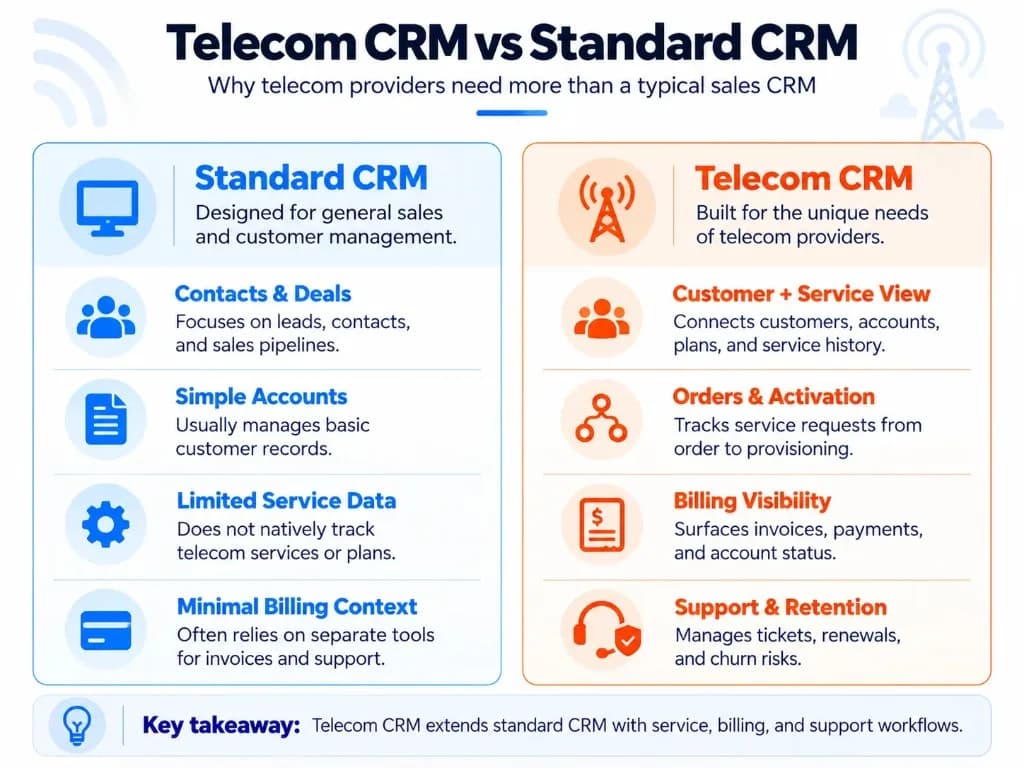
A general CRM is usually designed around relationships such as:
contact → company → lead → opportunity → sale
A telecom CRM has to represent another layer:
customer → account → subscription → service → device/SIM/number → orders → bills → support interactions
Consider a business customer with 20 locations. The company may be one customer, but it could have multiple billing accounts, dozens of circuits or phone lines, different contract dates and many active services. B2B CRM patterns for multi-contact accounts help here, but telecom still needs service-level context on top.
A support representative cannot resolve that customer's problem using only a name, phone number and deal history. They may also need to know which service is affected, whether it is active, what plan it uses, whether an order is pending, what was billed and whether another team is already handling the issue—the same need that shows up in CRM for call centers when agents need full context on first contact.
This is why purpose-built telecom CRM products emphasize service information, account hierarchies, billing visibility and provisioning alongside conventional sales and customer-service functionality. Like ecommerce CRM or CRM for retail, the records have to match how value is actually delivered.
For mobile providers, the customer context can also include prepaid or postpaid status, SIM/eSIM information, telephone numbers, activation state, upgrades, top-ups and plan changes. Strong CRM data management matters because incomplete subscription or account records make support and retention unreliable.
How CRM, BSS and OSS Work Together?
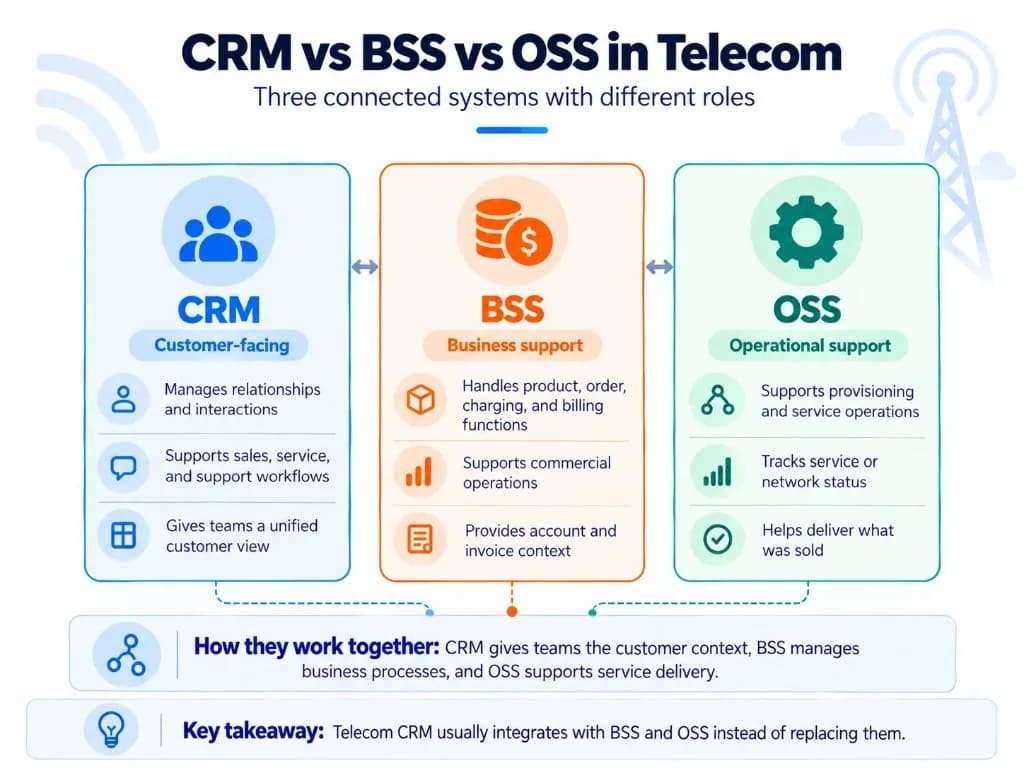
One of the easiest mistakes is treating telecom CRM, BSS and OSS as interchangeable systems.
They overlap, and vendors package them differently, but their roles are generally distinct—similar to how CRM in finance sits beside core banking systems, or how CRM for insurance agents works alongside an AMS.
| System | Primary role |
|---|---|
| CRM | Customer relationships, interactions, sales and customer-facing workflows |
| BSS | Commercial processes such as products, orders, charging, billing and payments |
| OSS | Operational/service processes such as provisioning, activation and network/service management |
A telecom CRM therefore does not have to replace every billing or operational platform.
Instead, it may become the customer-facing orchestration layer through which an agent sees information and starts actions that are fulfilled by other systems.
TM Forum's telecommunications API framework illustrates this separation clearly. It defines individual standardized interfaces for Customer Management, Product Ordering, Trouble Tickets, Customer Bill Management and Service Activation rather than treating all of them as one CRM function.
For example, imagine a customer calls because a newly ordered internet service is not working.
The CRM can identify the customer and account, show the order and previous conversations, retrieve the service's activation state from operational systems, display billing information and create or update a support ticket.
The agent gets one customer context even though several systems may provide the underlying information.
That distinction is important: a 360-degree customer view does not necessarily mean the CRM is the master database for every field it displays. CRM metrics and CRM analytics then help leaders see whether support, renewals, and service changes are actually improving outcomes.
What Information Does a Telecom CRM Bring Together?
A useful telecom customer view normally combines several categories of information.
Customer and account information
This includes identity, contact information, account relationships, addresses, preferences, contracts and—in B2B environments—parent/child account structures.
Products, subscriptions and services
Customer-facing teams need to know what the customer purchased and what is currently active: plans, lines, circuits, add-ons, devices, SIMs/eSIMs or other services relevant to the provider.
Orders and service changes
The CRM should expose new orders, upgrades, downgrades, cancellations and their current status so customers are not forced to repeat information to different departments.
Billing and payment context
Agents may need invoice history, payment status, balances or adjustments to understand a complaint or account request.
TimelyBill's telecom CRM, for example, places services, invoices, payment history, support tickets, quotes and provisioning information around the customer account.
Interaction and support history
Calls, emails, messages, tickets and previous resolutions help the next agent understand what has already happened.
Usage or service information
Where appropriate, the CRM can receive selected usage, activation or service-status information from other platforms. That information helps customer-facing teams understand the context behind a customer's request without turning the CRM itself into a network-management system.
Core Telecom CRM Capabilities
The exact feature set varies by operator, but six capabilities consistently matter.
1. A unified customer, account and service view
Employees should be able to move from a customer to the relevant account, subscription and service without searching multiple disconnected records. CRM systems only help when that path stays clear for the people who use it every day.
2. Order and activation coordination
The CRM should preserve the connection between what was sold and what must be delivered.
Order-management systems typically work from catalog-defined products, while service-activation systems handle the operational work needed to make a service available. TM Forum maintains separate standardized interfaces for both processes.
3. Billing visibility
Customer service frequently involves billing questions. Telecom CRM therefore needs either native billing capability or reliable integration with the billing platform.
The requirement is visibility and consistency—not necessarily forcing CRM to become the billing engine.
4. Customer service and ticket management
A support ticket is more useful when it remains attached to the customer's account and affected service.
Telecom systems may also synchronize trouble tickets with operational or partner systems. TM Forum's Trouble Ticket API specifically supports creating, tracking and updating such tickets across systems.
5. Workflow automation
Automation is particularly useful at departmental boundaries.
A completed sale can initiate ordering. An approved order can trigger provisioning activities. A service change can update billing. A complaint can be routed according to severity. A nearing contract date can create a renewal task.
The objective is not automation for its own sake. It is preventing customer requests from disappearing during handoffs. Sales automation can help with reminders and routing, but complex service decisions stay with people who have the right operational context.
6. Retention and relevant offers
Once customer, subscription, interaction and billing information can be analyzed together, telecom companies can identify patterns such as frequent support problems, approaching renewals or services that no longer fit the account.
CRM can then support retention, upgrades and cross-sell activity without separating those actions from the existing customer relationship. Salesforce and Gigs both position lifecycle data and customer behavior as inputs to retention and sales opportunities.
Where Telecom CRM Implementations Commonly Fail?
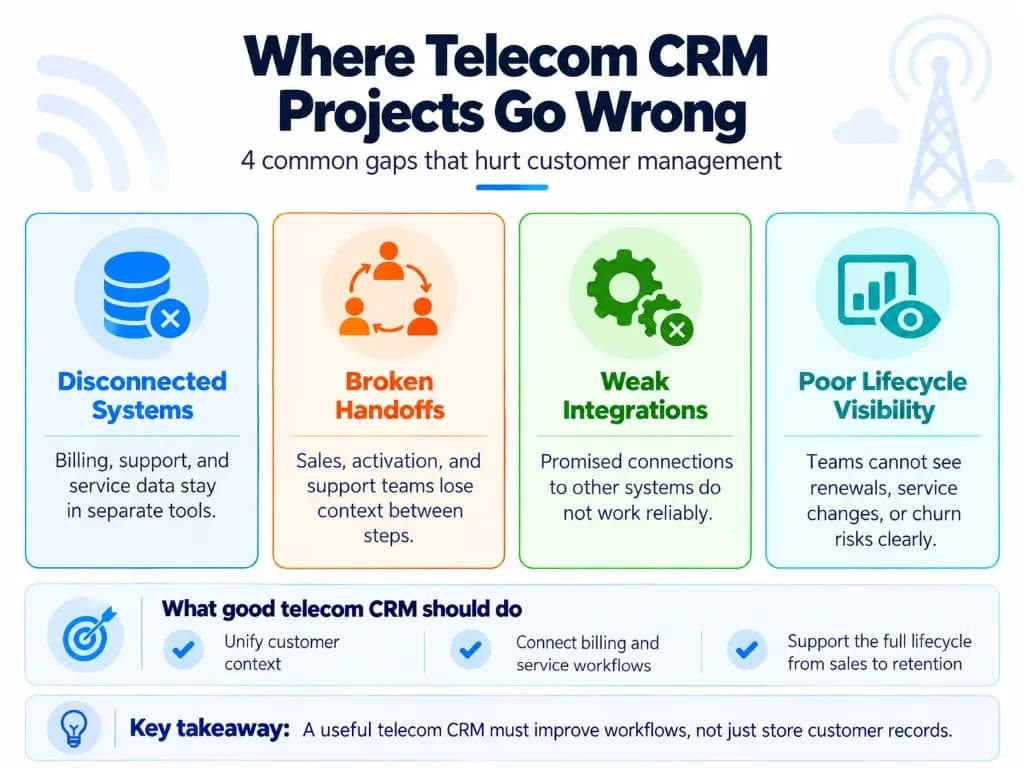
The hardest problem is often not storing customer names. It is connecting systems reliably.
In discussions among ISP/WISP operators, integration repeatedly appears as a practical frustration. Operators describe having separate systems for billing, network management, sales and customer communications, with supposedly supported integrations failing to provide the visibility they expected—the same failure mode that drives teams back to spreadsheets.
Another recurring issue is the lead-to-customer handoff. One operator described industry platforms that handled existing subscriber billing reasonably well but provided weak sales funnels and lead management, forcing the business to operate separate systems and then solve the handoff between them. Weak user adoption turns even a capable platform into another silo.
Migration also matters. Moving years of customer, service and billing information from an established platform can be difficult even when the replacement system is better afterward. That practical test matters more during CRM implementation than any marketing demo.
These experiences suggest that telecom companies should evaluate CRM by the quality of the complete workflow, not by the length of the feature list. Pharmaceutical CRM faces a similar choice between specialist and configurable platforms: the label matters less than workflow fit.
What Should a Telecom CRM Do Well?
A telecom CRM should ultimately answer five practical questions:
- Can an employee see the complete customer, account and service context without opening several systems?
- Can sales, ordering, provisioning, billing and support exchange the information they need reliably?
- Can the CRM model the provider's real customer structure—including multiple services, locations or subscriptions?
- Can routine handoffs and customer actions be automated without creating duplicate or stale data?
- Can access to customer and service information be controlled appropriately?
If those foundations are missing, dashboards, AI assistants and large feature lists will not solve the underlying customer-management problem.
A good telecom CRM therefore is not simply a bigger version of a normal sales CRM. It is the customer-facing layer that keeps the relationship connected while orders, services, bills and support activity move through the systems that run a telecommunications business. If off-the-shelf tools force awkward workarounds, plan for custom CRM development only after the core workflow is clear. The lightest system that supports measurable business growth is usually better than the heaviest one. CRM development and CRM platforms both matter when configuration depth becomes the deciding factor.
Frequently Asked Questions (FAQs)
What does CRM stand for in telecom?
CRM stands for Customer Relationship Management. In telecom, it refers to systems that manage customer or subscriber information, interactions, services, subscriptions, orders, billing context, and support throughout the customer lifecycle.
Can a telecom company use a standard CRM?
Yes, especially when customer relationships and sales processes are relatively simple. However, telecom providers often need additional integrations or customization for recurring services, subscriptions, provisioning, billing, SIMs or numbers, and complex account structures that standard CRMs do not handle natively.
Does a telecom CRM include billing?
A telecom CRM may include billing capabilities, but it does not have to be the billing system itself. Many providers connect CRM with a separate billing or BSS platform so customer-facing teams can see invoices, balances, payments, and service information without duplicating the billing engine.
Why does a telecom company need CRM if it already has billing software?
Billing software primarily calculates charges, generates invoices, and processes payments; CRM manages the broader customer relationship, including leads, interactions, sales, support, and service history. ISP operators discussing their software stacks frequently distinguish these needs and often use multiple connected systems rather than expecting billing software to replace CRM entirely.
Is CRM part of BSS in telecom?
CRM is commonly considered a customer-facing component of the broader BSS environment. BSS also includes functions such as billing, product management, charging, and order management, while OSS generally handles network-facing processes such as provisioning, monitoring, and service assurance.
What systems should a telecom CRM integrate with?
A telecom CRM should connect with the systems needed to complete the customer lifecycle, commonly including billing and charging, order management, provisioning or OSS, ticketing, payment systems, and communication channels. The exact integrations depend on the provider, but reliable data exchange is more important than simply having a long integration list.
Can telecom CRM manage both sales leads and existing subscribers?
Yes, a well-designed telecom CRM can connect the acquisition process with ongoing subscriber management, allowing information collected during sales to continue into ordering, activation, support, and renewal. This handoff matters because telecom operators have reported that some industry platforms manage existing customers well but provide weak lead and sales workflows, forcing teams to bridge separate systems manually.