
Quick Summary
- Constituent CRM and customer CRM share the same foundations but serve different purposes: Customer relationship management primarily focuses on customers, sales, and commercial relationships, while constituent relationship management supports donors, volunteers, members, program participants, and other stakeholders connected to an organization's mission.
- The biggest differences involve goals, workflows, and success metrics: Traditional CRM commonly tracks sales opportunities, purchases, and customer retention. Constituent CRM emphasizes donations, fundraising, memberships, volunteer participation, stakeholder engagement, and mission-related outcomes that extend beyond revenue—and beyond what CRM metrics designed only for conversion usually measure.
- Constituent CRM manages multiple relationships within a single contact record: One person can simultaneously be a donor, volunteer, and member. Connecting their contributions, participation, communications, and membership history helps organizations coordinate activities without maintaining disconnected records—strong CRM data management and contact management practices still apply.
- Traditional CRM software can support constituent management without requiring a separate platform: General-purpose systems such as Salesforce can be configured for nonprofit workflows, while specialized solutions may offer built-in fundraising and membership capabilities. The difference lies in functionality, customization requirements, and ongoing maintenance—often the same build-versus-buy questions covered in CRM development and CRM implementation planning.
- The right CRM depends on organizational needs, not software labels: Evaluate whether the system supports your constituent types, relationship structures, essential workflows, reporting, and data permissions. Prioritize native capabilities and manageable CRM integrations over features that require extensive customization or introduce unnecessary complexity.
What Does CRM Mean in Each Context?
CRM commonly stands for Customer Relationship Management, the strategy and software businesses use to manage customer and prospect relationships. It brings contact details, communications, sales activities, and service history into a shared system—the same foundation described in our CMS vs CRM differences guide.
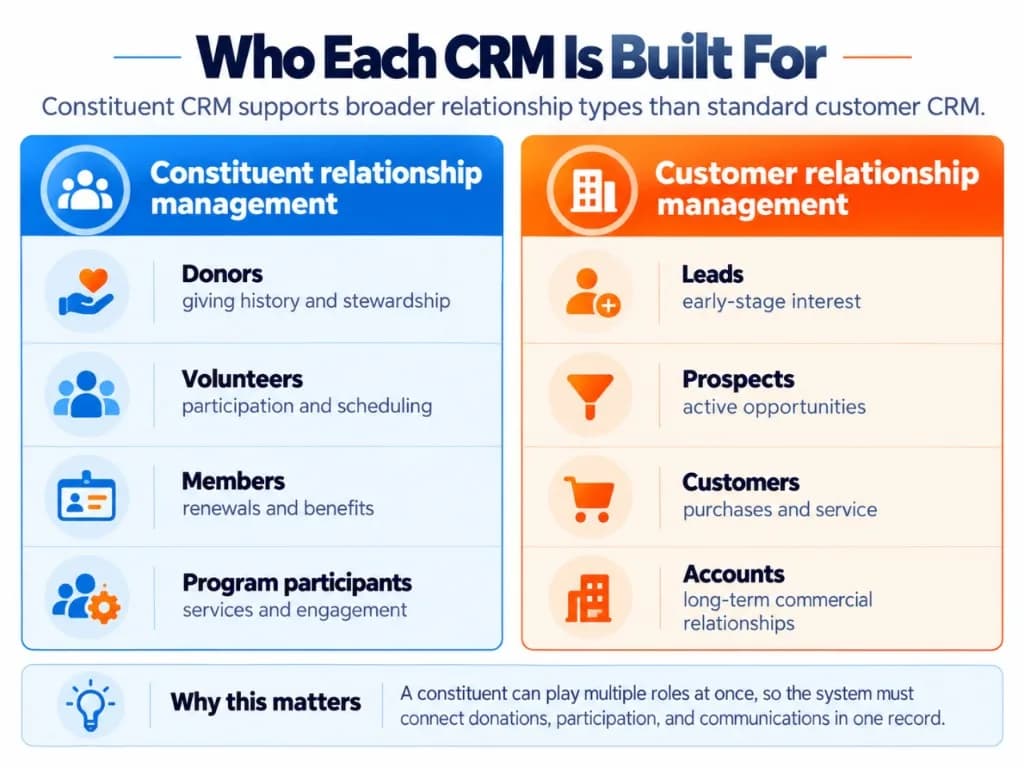
In nonprofit organizations, educational institutions, associations, and advocacy groups, CRM can also stand for Constituent Relationship Management.
A constituent is a person or organization that has a relationship with, participates in, supports, or is served by an organization. Constituents might include donors, volunteers, students, alumni, members, funders, or community partners.
For example, a business may use CRM to track a prospective customer from initial inquiry to purchase. A nonprofit might use constituent CRM to record when someone donates, volunteers at an event, joins a membership program, or receives organizational communications.
The underlying relationship-management principles are similar. What changes is the purpose of those relationships and the activities associated with them. CRM for service businesses and B2B CRM teams still optimize for commercial outcomes; constituent systems optimize for mission support.
Constituent Relationship Management vs Customer CRM: Key Differences
Both approaches use CRM software to organize contacts and interactions, but they prioritize different stakeholders, workflows, and success measures.
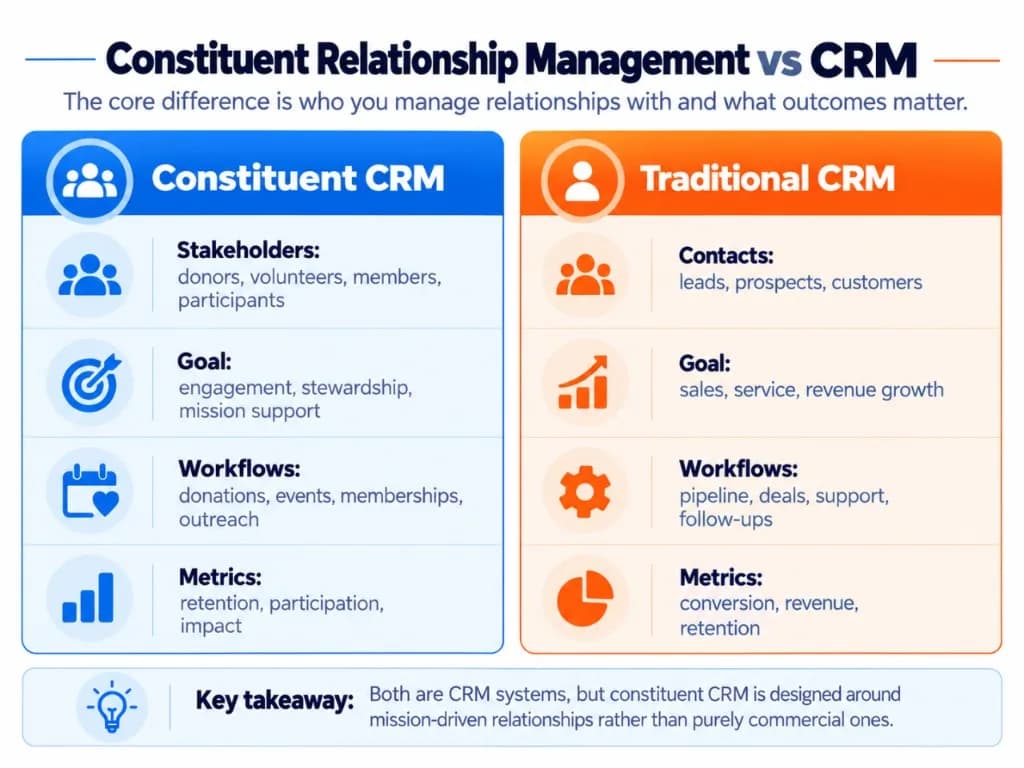
| Comparison | Customer Relationship Management | Constituent Relationship Management |
|---|---|---|
| Primary focus | Customers and prospects | Constituents and stakeholders |
| Common users | Businesses and commercial teams | Nonprofits, associations, universities, advocacy groups |
| Main objective | Improve customer relationships and commercial outcomes | Strengthen stakeholder relationships and achieve organizational goals |
| Typical contacts | Leads, customers, business accounts | Donors, volunteers, members, participants, partners |
| Common workflows | Lead management, sales opportunities, account management, customer service | Donations, pledges, volunteering, memberships, programs, outreach |
| Relationship records | Customer history, sales activity, purchases, support interactions | Giving history, participation, memberships, engagement, service interactions |
| Performance measures | Revenue, conversion, retention, service outcomes | Donor retention, volunteer involvement, membership renewals, program results |
| Specialized capabilities | Sales forecasting, opportunity management, service workflows | Gift tracking, stewardship, membership rules, volunteer coordination |
| Primary reporting audience | Sales, marketing, service, and business leadership | Fundraising teams, program staff, executives, boards, and funders |
These are typical differences rather than strict limitations. A traditional CRM may support constituent activities through configuration, while nonprofit-oriented platforms may also manage commercial transactions.
The shared foundation is contact management, communication history, workflow coordination, and reporting. The distinction becomes more important when organizations need specialized records and processes—similar to how CRM vs CXM comparisons separate relationship records from experience measures.
How Constituent CRM Changes Everyday Relationship Management?
One Constituent Can Have Multiple Roles
A constituent's relationship with an organization may involve several roles simultaneously.
Consider someone who contributes $100 to a community nonprofit, volunteers twice a month, attends an annual fundraiser, and serves on an advisory committee.
Those activities involve the same person but represent different forms of engagement.
A constituent CRM can connect them through one relationship view:
- Their donation history shows financial support.
- Their volunteer participation shows contributions of time.
- Their event attendance shows involvement.
- Their committee membership shows an organizational responsibility.
Without coordinated records, fundraising staff might recognize the person as a donor while the volunteer coordinator knows them only as a volunteer.
This is why constituent relationship management involves more than storing a list of supporters. The system needs to represent the different relationships and activities associated with each constituent—usually stored in a reliable CRM database with clear ownership of fields and history.
Traditional CRM platforms can also model complex relationships, but the available functionality and configuration requirements vary. CRM system proficiency still matters when staff must navigate roles, permissions, and related records.
Financial and Nonfinancial Activities Belong Together
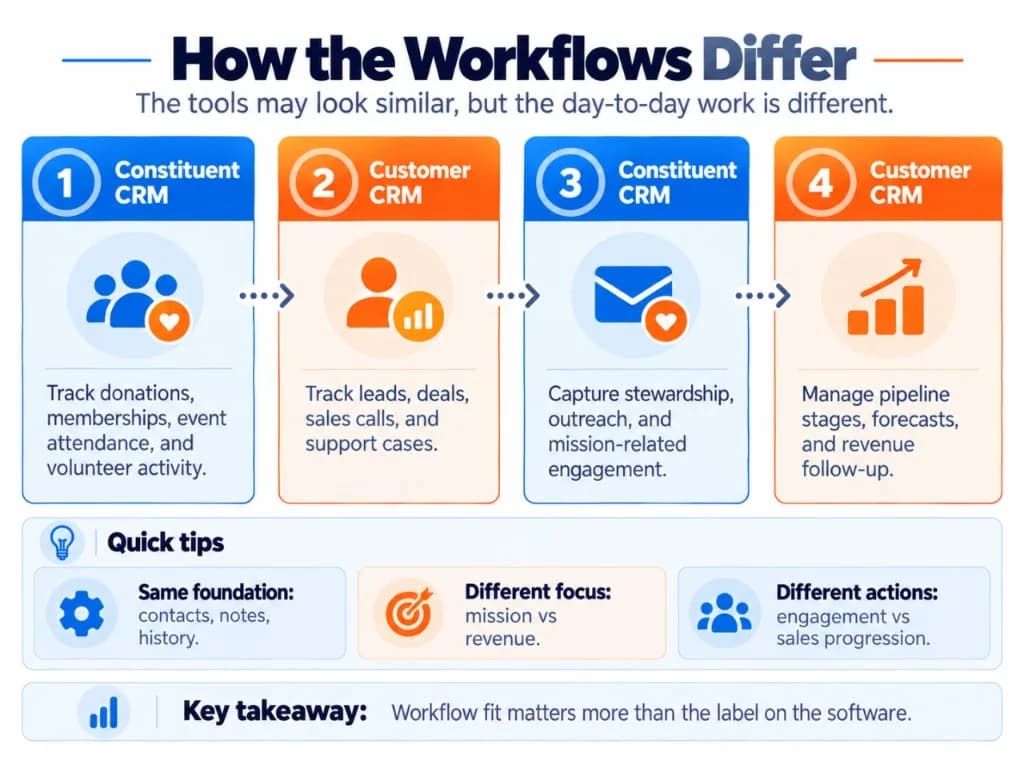
Customer CRM often organizes important workflows around purchases, sales opportunities, and service needs.
Constituent CRM may organize them around contributions and participation that do not involve a purchase.
For example, a nonprofit may need to manage:
- A donor's pledge and recurring contributions.
- A member's renewal date.
- A volunteer's participation history.
- A program participant's service interactions.
- A foundation's grant commitments.
These activities create different records and follow-up requirements.
A completed donation might trigger an acknowledgment. An expiring membership might require a renewal reminder. A volunteer's participation might support engagement reporting.
The organization may also need to measure outcomes that cannot be represented by revenue alone, such as volunteer participation or people served—where CRM analytics focused only on the sales pipeline miss important mission results.
Official CiviCRM documentation demonstrates these distinctions through separate contribution, membership, event, and activity functionality. Salesforce's fundraising data model similarly includes gifts, commitments, recurring donations, and related constituent records.
Practical Examples of Constituent CRM vs Customer CRM
Example 1: A Retail Business Using Customer CRM
An electronics retailer receives an inquiry about a laptop.
Its CRM records the prospect's contact details, the product of interest, previous communications, and the status of the sales opportunity.
After a purchase, the system may help manage follow-up communications and customer support—familiar CRM for retail and ecommerce CRM patterns.
What this demonstrates: The relationship is managed primarily through commercial interactions, although customer CRM can support much more than the initial sale.
Example 2: A Community Nonprofit Using Constituent CRM
A community food assistance organization works with donors, volunteers, partner organizations, and program participants.
A supporter first contributes money, later volunteers at a distribution event, and eventually becomes a regular volunteer.
The organization's CRM records those interactions as part of the person's ongoing involvement. Staff can use the appropriate information for fundraising communications, volunteer coordination, and engagement reporting.
Program participant information may require different access permissions from fundraising or volunteer data—closer to CRM for government and CRM for insurance agents expectations around restricted records.
What this demonstrates: Constituent CRM needs to represent different roles and activities while protecting information that should not be available to every staff member. Good CRM notes help teams share context without exposing unnecessary personal details.
Example 3: A University Managing Constituent Relationships
A university communicates with prospective students, enrolled students, graduates, alumni donors, and community partners.
A prospective student might become an enrolled student, graduate, and later participate in alumni events or fundraising.
A constituent relationship management system helps the institution track relevant interactions across those relationships.
The University of Texas at Arlington describes constituent CRM as a way to centralize recruitment-related conversations and information, supporting prospective students and the university's broader community.
What this demonstrates: Constituent relationship management is not limited to charitable donations. It can support educational, membership, and community relationships—beyond the commercial focus of CRM for inside sales or CRM for manufacturing.
Can Traditional CRM Software Handle Constituent Relationships?
Yes. A traditional CRM can support constituent relationship management if it provides the required data structures, workflows, and integrations.
Organizations do not automatically need to replace a general-purpose CRM simply because their contacts are donors or members rather than paying customers.
The important distinction is between what a platform can be configured to do and what it supports through existing, maintained functionality.
A general CRM may already handle contact records, email communications, activity tracking, reporting, and basic engagement workflows—especially on cloud-based CRM platforms.
Additional requirements may include recurring gifts, donation attribution, volunteer participation, household relationships, membership terms, or specialized program records.
A nonprofit-focused CRM may support some of these processes directly. A general-purpose CRM may require configuration, CRM integrations, or custom CRM development.
However, a nonprofit-specific product is not guaranteed to cover every mission-related activity. Some platforms primarily serve fundraising teams, while others also support membership, volunteering, advocacy, or program delivery.
Before choosing, verify three things:
- Data model: Can the software represent the relationships and records your organization actually uses?
- Workflow support: Are essential activities handled natively, through maintained integrations, or through custom development?
- Ongoing effort: What will configuration, training, data migration, maintenance, and future changes require?
The most suitable option is the one that handles the organization's important relationships reliably without unnecessary operational complexity. Sales automation and marketing automation can still help, but only after the relationship model fits.
How Does Salesforce Support Constituent Relationship Management?
Salesforce is widely associated with customer relationship management, but its platform also supports constituent-focused nonprofit operations.
Salesforce has nonprofit-specific offerings, including Nonprofit Success Pack (NPSP) and its newer nonprofit platform solutions.
NPSP uses nonprofit-oriented records and relationships for functions such as fundraising, donors, households, memberships, and recurring donations.
Salesforce's newer nonprofit offerings use different data models and capabilities. Official documentation now refers to Agentforce Nonprofit, formerly Nonprofit Cloud. Salesforce continues to provide documentation for NPSP, but the two approaches should not be assumed to have identical configurations or migration requirements.
This distinction matters because adopting nonprofit functionality does not always mean adding a few custom fields to a standard sales system.
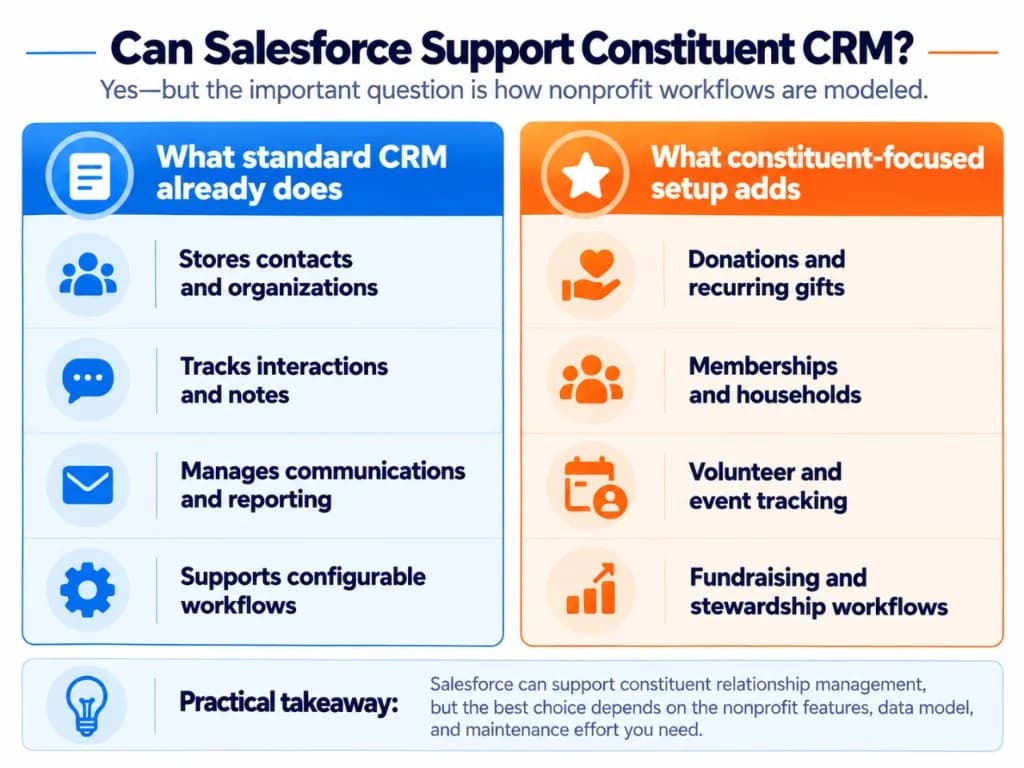
For organizations evaluating Salesforce, the relevant question is which nonprofit product or configuration supports their required constituent relationships and workflows—not simply whether Salesforce is a customer CRM. Teams comparing relationship tools more broadly may also review CRM vs project management software when program delivery work sits outside the CRM.
How to Choose the Right CRM Approach?
Start with the activities your organization must manage every day.
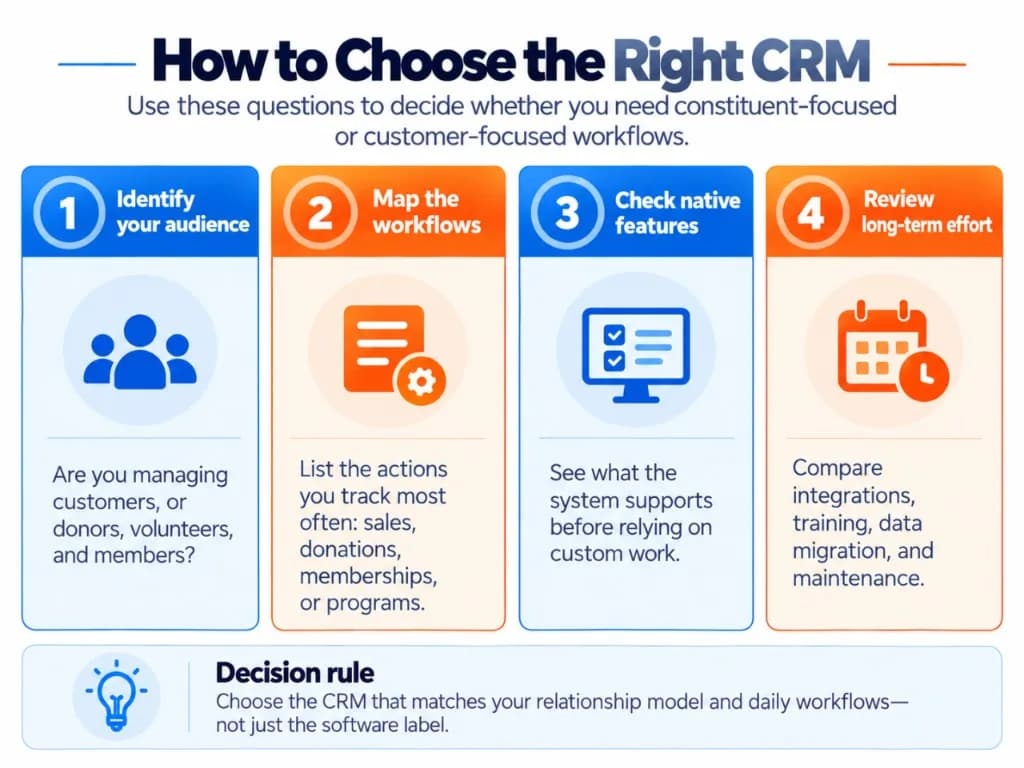
| Your organization's main requirement | Approach to prioritize |
|---|---|
| Managing sales opportunities, customer accounts, and commercial service | Customer-focused CRM workflows |
| Tracking donors, giving history, and fundraising relationships | Constituent CRM with fundraising functionality |
| Managing volunteers, members, or program participation | CRM with the corresponding native or integrated workflows |
| Managing both commercial customers and nonprofit constituents | A configurable platform or coordinated systems supporting both |
| Already using a general-purpose CRM | Evaluate configuration and integration before considering replacement |
The software demonstration should use actual organizational scenarios rather than generic vendor examples.
For instance, ask the provider to show how the system manages a person who is simultaneously a donor, volunteer, and member. Verify that staff can find relevant interactions, manage renewals and follow-ups, generate appropriate reports, and restrict access to sensitive information.
Also distinguish a feature that is immediately available from one that requires an additional product, integration, or custom build—especially when CRM for digital marketing campaigns need both engagement history and permission controls.
The deciding factor is the fit between the software's relationship model and your organization's work. A platform labeled customer CRM may meet constituent needs, while a nonprofit-branded CRM may still lack functionality essential to a particular organization. Operational CRM day-to-day work still depends on reliable records either way, and the choice should support long-term business growth without unnecessary platform sprawl.
Frequently Asked Questions
Can a nonprofit use one CRM for fundraising and program management?
Yes, a constituent CRM can manage fundraising and program activities in one system if it supports both workflows. Donor records, program participation, and communications can be connected while maintaining appropriate staff permissions. However, some organizations use separate systems when their departments have substantially different requirements—similar to CRM for call centers separating ticket work from fundraising access.
Can constituent CRM software manage client cases as well as donor relationships?
Yes, some constituent CRM platforms support case management, including client intake, referrals, assessments, service plans, and participation tracking. However, these capabilities are not standard in every CRM. Organizations delivering social or community services should verify case-management functionality and confidentiality controls before choosing a platform. Pharmaceutical CRM and Telecom CRM programs face similar permission questions when one platform serves multiple teams.
Can someone be a donor, volunteer, and member in the same CRM without duplicate records?
Yes, a properly configured constituent CRM can associate multiple roles and activities with one contact record. Donations, volunteer participation, and memberships can be tracked separately while remaining connected to the same person. Duplicate-matching rules are important when importing data or collecting information through different forms—core CRM data management discipline.
Is Salesforce Nonprofit Success Pack the same as Nonprofit Cloud?
No. Nonprofit Success Pack (NPSP) is a Salesforce managed package, while Nonprofit Cloud, now called Agentforce Nonprofit, is an integrated nonprofit platform solution with a different architecture. Both support constituent relationships, but their data models and capabilities differ. Moving from NPSP to Agentforce Nonprofit requires migration planning rather than a simple upgrade.
Does a constituent CRM replace accounting software like QuickBooks?
Generally, no. Constituent CRM tracks donations, pledges, donor relationships, and fundraising activities, while accounting software manages financial ledgers, bank reconciliation, and financial statements. Organizations often connect the two systems to reduce duplicate entry while maintaining reliable financial records—another case for careful CRM integrations.
What is the difference between a donor database and constituent relationship management?
A donor database primarily manages donor information, contributions, and fundraising history. Constituent relationship management covers a broader range of relationships, potentially including volunteers, members, program participants, and organizational partners. Some donor management systems provide these additional capabilities, so the difference depends on the software's actual functionality.
Does a small nonprofit need specialized constituent CRM software?
Not necessarily. A small nonprofit with limited contacts and simple workflows may manage relationships using spreadsheets or a basic CRM. Specialized constituent software becomes more useful as donor records, volunteer activities, membership data, and staff responsibilities become harder to coordinate. The need depends more on workflow complexity than organizational size alone—and CRM for real estate or CRM in finance teams make similar complexity-based decisions.