
Quick Summary
- CRM is used across nearly every major industry: Retail, manufacturing, healthcare, real estate, finance, insurance, education, technology, and government use CRM software to manage customer relationships, organize interactions, and coordinate follow-ups. However, the information and workflows they manage differ significantly—whether teams run CRM for retail counters or CRM for manufacturing dealer networks.
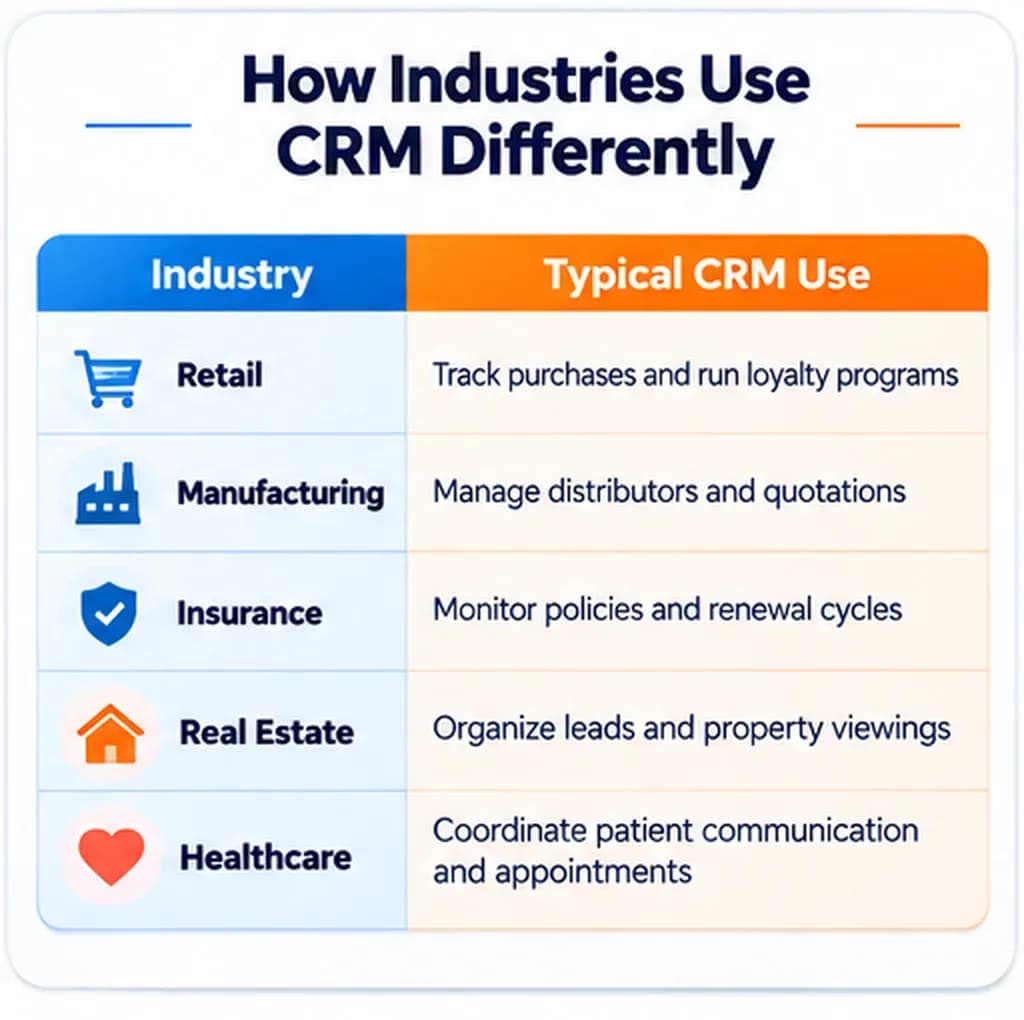
- Different industries use CRM for different purposes: Retailers track purchase history and loyalty programs, manufacturers manage distributor accounts and quotations, insurance agencies monitor policy renewals with CRM for insurance agents workflows, and real estate businesses coordinate property inquiries through CRM for real estate pipelines.
- Industry-specific workflows determine CRM requirements: The biggest differences involve the relationships being tracked, the events that trigger follow-ups, and the information employees need. A manufacturer's distributor accounts require different records and processes than a retailer's individual customer profiles, which is why solid CRM data management matters before customization.
- CRM often works alongside specialized business systems: Manufacturers may connect CRM with ERP software, retailers with ecommerce or point-of-sale platforms, and healthcare organizations with approved patient-management systems. These CRM integrations support customer-facing activities without replacing core operational software or overlooking applicable privacy requirements.
- Not every industry needs specialized CRM software: General-purpose CRM platforms can support businesses with straightforward contact management, sales tracking, and follow-up needs. Industry-specific solutions become more valuable when specialized records, complex workflows, regulatory requirements, or integrations are essential to daily operations—sometimes after CRM consulting clarifies the gap.
Customer relationship management (CRM) software is used across industries, including retail, manufacturing, healthcare, real estate, finance, insurance, education, and technology. While these businesses share the need to manage relationships and customer interactions, the way they use CRM depends on their customers, sales processes, and service requirements.
A retailer might use CRM to personalize offers based on purchase history. A manufacturer may track distributor relationships and quotations, while an insurance agency uses it to manage policy renewals.
The difference is not simply which industry uses CRM, but what information each business tracks and what actions that information triggers—skills that also show up in everyday CRM system proficiency.
Which Industries Use CRM? Uses and Examples
Most industries that manage ongoing customer, client, patient, partner, or constituent relationships can benefit from CRM. However, the relationships being managed and the workflows required vary considerably.
The following table compares common CRM applications across different industries.
| Industry | How CRM Is Used | Practical Example |
|---|---|---|
| Retail | Tracks shopping preferences, purchase history, loyalty activity, and customer communications. | A clothing retailer sends relevant offers to customers based on previous purchases. |
| Ecommerce | Connects online customer interactions with order history, abandoned carts, marketing, and support. | An online store follows up on an abandoned checkout or a delivery-related inquiry. |
| Manufacturing | Manages distributor accounts, B2B customers, quotations, sales opportunities, and after-sales relationships. | A machinery manufacturer reminds an account manager to follow up on an outstanding distributor quote. |
| Automotive | Tracks vehicle inquiries, dealership interactions, test drives, ownership relationships, and service opportunities. | A dealership follows up with a buyer after a test drive and coordinates future service reminders. |
| Financial Services | Organizes client relationships, financial-service inquiries, appointments, and ongoing account communications. | A financial advisor schedules a review with a client and records the agreed follow-up actions. |
| Insurance | Coordinates prospects, policyholder communication, quotations, renewals, and service inquiries. | An insurance agent receives a reminder to contact a policyholder before renewal. |
| Healthcare | Supports patient inquiries, appointment communications, outreach, and nonclinical relationship management. | A clinic coordinates an appointment reminder or responds to a patient service inquiry. |
| Real Estate | Connects buyers, sellers, landlords, tenants, properties, and transaction opportunities. | An agent matches a buyer's requirements with a newly available property and schedules a viewing. |
| Professional Services | Manages prospects, client relationships, proposals, consultations, and repeat engagements. | A consulting firm tracks a proposal and schedules its next client discussion. |
| Home and Field Services | Organizes customer inquiries, service estimates, appointments, and follow-up communication. | An HVAC contractor follows up on an installation estimate and schedules a maintenance reminder. |
| Travel and Hospitality | Tracks guest preferences, reservations, service requests, and post-visit communications. | A hotel records a returning guest's preferences to support a more consistent experience. |
| Telecommunications and Utilities | Connects customer accounts with service requests, complaints, support history, and relevant notifications. | A telecom provider links repeated connectivity complaints to an existing customer case. |
| Technology and SaaS | Manages business accounts, product inquiries, subscriptions, onboarding, and renewal conversations. | A software company alerts an account manager about an approaching subscription renewal. |
| Education | Coordinates admission inquiries, prospective students, communications, and enrollment follow-ups. | A university admissions team tracks an applicant's questions and outstanding application steps. |
| Government and Public Services | Organizes resident inquiries, constituent interactions, service requests, and case communications. | A local authority assigns a resident's service request to the appropriate department. |
| Nonprofits | Manages donor relationships, fundraising communications, volunteer engagement, and constituent outreach. | A charity follows up with a recurring donor and records their communication preferences. |
| Pharmaceuticals | Supports authorized relationships with healthcare professionals, field-team interactions, and account communications. | A pharmaceutical representative records an approved professional engagement and schedules a permitted follow-up. |
| Logistics and Transportation | Tracks shipper accounts, service inquiries, commercial opportunities, and customer communication. | A logistics provider follows up with a business customer about a requested shipping contract. |
| Consumer Goods | Supports retailer and distributor relationships, account-level promotions, customer feedback, and product engagement. | A consumer goods brand coordinates a promotional campaign with its retail partners. |
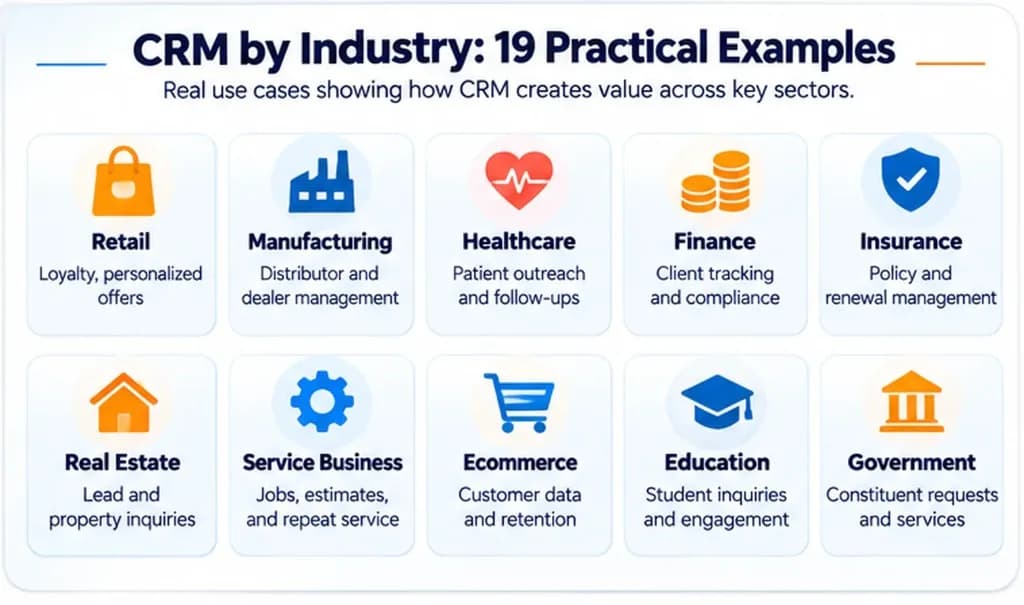
These are illustrative industry workflows, not claims about the implementation or results of any specific company.
The same CRM platform may support several of these industries, but it usually needs different fields, processes, permissions, and integrations to fit each business—whether that means ecommerce CRM practical strategies, pharmaceutical CRM compliance rules, telecom CRM case history, or CRM for government constituent routing.
When those patterns are clear, teams can also compare CRM vs CXM if experience tooling overlaps with relationship records.
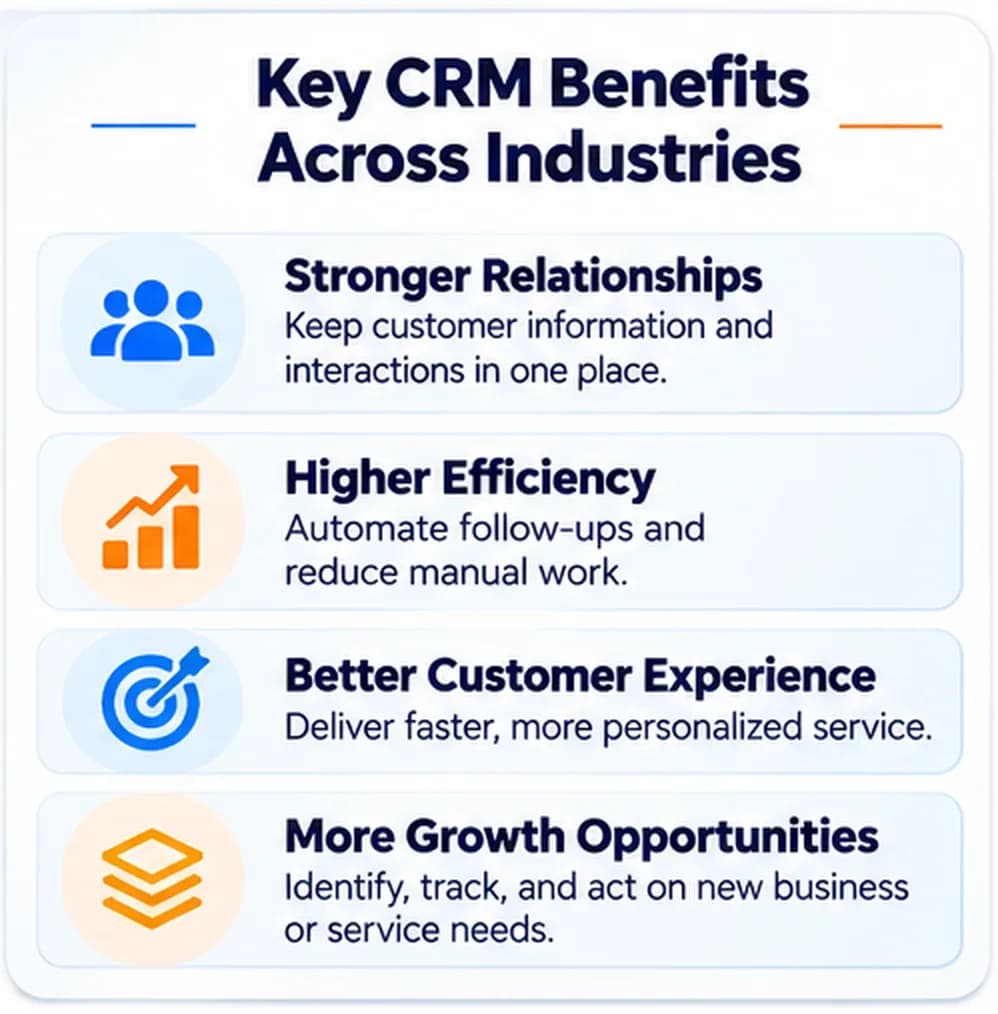
How CRM Requirements Differ Across Industries
CRM requirements differ mainly in three areas: the relationships being managed, the events that require follow-up, and the systems containing related business information.
1. Different Industries Manage Different Relationships
A CRM record does not always represent an individual consumer.
In retail, customer profiles commonly connect individuals with purchases, preferences, and loyalty interactions. In manufacturing, a record may represent a company, with multiple purchasing contacts, quotations, and distributor relationships—classic B2B CRM account design.
Real estate businesses may need to connect contacts with multiple properties and transactions. Insurance agencies need to associate policyholder relationships with policies and renewal dates. Nonprofits may manage donors, volunteers, and organizational supporters, which can resemble constituent CRM structures used in public-sector outreach.
These differences determine which records and relationships the CRM must support, and how carefully teams practice CRM data entry so ownership stays trustworthy.
2. Follow-Up Workflows Depend on the Industry
CRM helps businesses turn customer-related events into organized actions, but those events are not the same everywhere.
Consider four examples:
- Retail: A customer purchases a product, creating an opportunity for relevant post-purchase communication.
- Manufacturing: A distributor requests a quotation, prompting a sales representative to follow up.
- Insurance: A policy approaches its renewal date, triggering a review reminder.
- Real estate: A buyer requests a viewing, creating a scheduling task for the assigned agent.
Each follows the same basic pattern: customer event → recorded context → assigned action → follow-up.
The industry determines which events matter, how quickly employees must respond, and which information they need to complete the task—often captured in CRM notes so the next owner has usable context.
3. Industry-Specific Systems and Data Requirements Matter
CRM does not necessarily replace the operational software used in an industry.
Manufacturers may connect CRM with enterprise resource planning (ERP) systems that manage orders and inventory. Retailers may use point-of-sale and ecommerce platforms as sources of transaction data. Healthcare organizations may integrate approved customer-engagement workflows with electronic health record (EHR) systems, while universities may rely on separate student information systems.
The purpose of these connections is to provide relevant relationship context without duplicating every operational function inside CRM. Teams still need to know how to connect a CRM safely so sync errors do not corrupt the CRM database.
Privacy requirements also differ. In the United States, healthcare organizations covered by HIPAA must account for protected health information when using CRM or connected software. Educational institutions must consider applicable student-record protections under FERPA.
A CRM product's general availability does not automatically make a particular deployment compliant. Data access, vendor responsibilities, configuration, and permitted uses must be evaluated for the actual situation—often with a CRM system administrator and, when needed, CRM consulting support during CRM implementation.
Real Examples of Companies Using CRM
Documented company cases show how CRM and related customer-engagement systems support different types of relationships.
1. Toyota Motor Philippines — Automotive Customer Relationships
Toyota Motor Philippines used SAP Sales and Service Cloud across its dealerships and expanded its connected customer-experience capabilities with additional SAP solutions.
According to SAP's customer story, the company focused on connecting customer journeys across physical dealerships and digital channels.
What this demonstrates: Automotive customer management can extend beyond the initial vehicle sale to consistent interactions across dealers, digital services, and ongoing ownership relationships.
2. ALDO Group — Retail Customer Engagement
Fashion retailer ALDO Group implemented SAP Commerce Cloud, SAP Emarsys, and SAP Customer Activity Repository as part of a connected commerce and customer-engagement ecosystem.
SAP's case study describes how these solutions connect transaction information, customer insights, inventory visibility, and personalized marketing—overlapping with CRM for digital marketing goals without replacing every store system.
What this demonstrates: Retail relationship management often depends on connecting shopping behavior with relevant customer engagement rather than managing a traditional sales pipeline.
This is an example of CRM-related customer-experience technology, not a claim that every component of ALDO's system is a standalone CRM.
3. Avison Young — Real Estate Client Management
Commercial real estate advisory firm Avison Young consolidated four separate CRM systems onto HubSpot's CRM platform to improve client visibility and coordination between brokers.
HubSpot's published customer story reports that CRM adoption among its 1,600 North American brokers rose from 23% to 90% within four months.
The firm also reported improved visibility into client relationships, sales activities, and business opportunities across offices—outcomes that depend on shared CRM metrics, not just more fields.
What this demonstrates: In relationship-driven industries such as commercial real estate, connecting client information across teams can be as important as managing individual deals.
These examples illustrate three distinct approaches: connected dealership relationships, transaction-informed retail engagement, and shared business-client records that support long-term business growth.
Does Every Industry Need Specialized CRM Software?
No. Businesses do not automatically need industry-specific CRM software simply because they operate in a particular sector.
A general-purpose CRM can often support businesses that primarily need contact records, lead tracking, communication history, and follow-up reminders. Custom fields and integrations may be sufficient for relatively straightforward workflows, including many CRM for service businesses and CRM for finance teams that start simple.
An industry-specific CRM becomes more useful when essential processes require specialized records, relationships, or controls that would otherwise be difficult to configure.
For example, a real estate business might need property-linked records, while an insurance agency may require policy-specific workflows. A manufacturer may need detailed account hierarchies and reliable connections to order-management systems—or even custom CRM development when templates cannot model the process.

The decision should depend on the actual workflow, not the industry label alone. Cloud-based CRM options often cover the basics quickly; specialized builds or CRM development come later when gaps are proven.
A useful way to assess industry fit is to ask:
- What type of relationship must the CRM manage?
- Which records or events need to be connected to that relationship?
- What follow-up actions must happen consistently?
- Which existing systems must provide or receive information?
- Are there industry-specific privacy, security, or process requirements?
If standard CRM software features can support these needs without excessive customization, a general-purpose platform may be sufficient. If specialized workflows are central to daily operations, an industry-specific solution may be more appropriate.
The underlying purpose of CRM remains consistent across industries: maintaining useful relationship information and helping people act on it. What changes is the customer context, the workflow, and the information needed to serve that relationship effectively—whether teams choose CRM for retail, CRM for manufacturing, CRM for real estate, or a broader operational CRM setup.
Frequently Asked Questions
Which industry uses CRM the most?
Technology and software companies are frequently among the leading industries for CRM adoption, alongside financial services, retail, and professional services. However, there is no universally established leader because studies measure different factors, including adoption rates, total users, and software spending. The ranking depends on the dataset and how CRM usage is defined.
Are CRM systems useful for businesses that don't sell products?
Yes. CRM systems are also useful for organizations that manage relationships rather than traditional product sales. Nonprofits use them to coordinate donors and volunteers, educational institutions manage student inquiries, and government agencies track constituent interactions and service requests with CRM for government patterns. The focus is relationship management rather than sales.
Do manufacturers need CRM software if they already use an ERP system?
Manufacturers may benefit from CRM even when they already have ERP software. ERP primarily manages operational processes such as inventory, production, and orders, while CRM focuses on customer inquiries, distributor relationships, quotations, and sales follow-ups—core CRM for manufacturing work. Some ERP platforms include CRM capabilities, so a separate system is only necessary when existing functionality does not meet those needs.
Can small service businesses benefit from CRM without a dedicated sales team?
Yes. Contractors, repair businesses, consultants, and other service providers can use CRM to organize customer information, track estimates, schedule follow-ups, and manage repeat service relationships under CRM for service businesses. A formal sales department is unnecessary, although businesses with few customers and simple workflows may find a spreadsheet sufficient.
Who uses CRM software besides sales teams?
CRM software is used by marketing, customer service, account management, and other customer-facing teams. For example, retail marketers use customer records to coordinate campaigns through CRM for digital marketing motions, healthcare administrative teams manage authorized patient communications, and nonprofit staff track donor engagement. The departments involved depend on the industry's relationship-management needs, and a CRM system administrator often coordinates access across those teams.