
Quick Summary
- The CRM landscape covers more than CRM software: It includes customer relationship management platforms, specialized sales and service applications, industry-specific solutions, and supporting technologies such as AI, automation, analytics, and integrations. Understanding these categories helps distinguish complete CRM systems from complementary tools—and from adjacent experience stacks often confused with CRM vs CXM debates.
- Major CRM vendors serve different market segments: Salesforce, Microsoft Dynamics 365, Oracle, and SAP dominate enterprise discussions, while HubSpot, Zoho CRM, and Pipedrive serve a range of business needs. Specialists such as Veeva and Attio differentiate through industry-specific capabilities or AI-native approaches, including pharmaceutical CRM and other vertical builds.
- AI is transforming CRM technology in 2026: Embedded AI, AI-native platforms, and autonomous agents increasingly support customer data analysis, interaction summaries, and workflow execution. However, their effectiveness depends on reliable CRM data management, system integrations, appropriate governance, and clear controls over automated actions.
- The CRM market is competitive despite established leaders: Salesforce held approximately 20% of the worldwide CRM applications market in 2025, according to IDC figures published in 2026. Numerous smaller vendors compete through specialization, flexibility, and focused functionality, making market share an unreliable indicator of individual business suitability—especially during CRM consulting and selection work.
- The best CRM depends on fit, not vendor popularity: Evaluate platforms by functional scope, industry requirements, integration capabilities, flexibility, governance, and total cost of ownership. Integrated suites can simplify coordination, while specialized applications offer targeted capabilities but may introduce additional integration complexity after CRM implementation begins.
What Is the CRM Landscape?
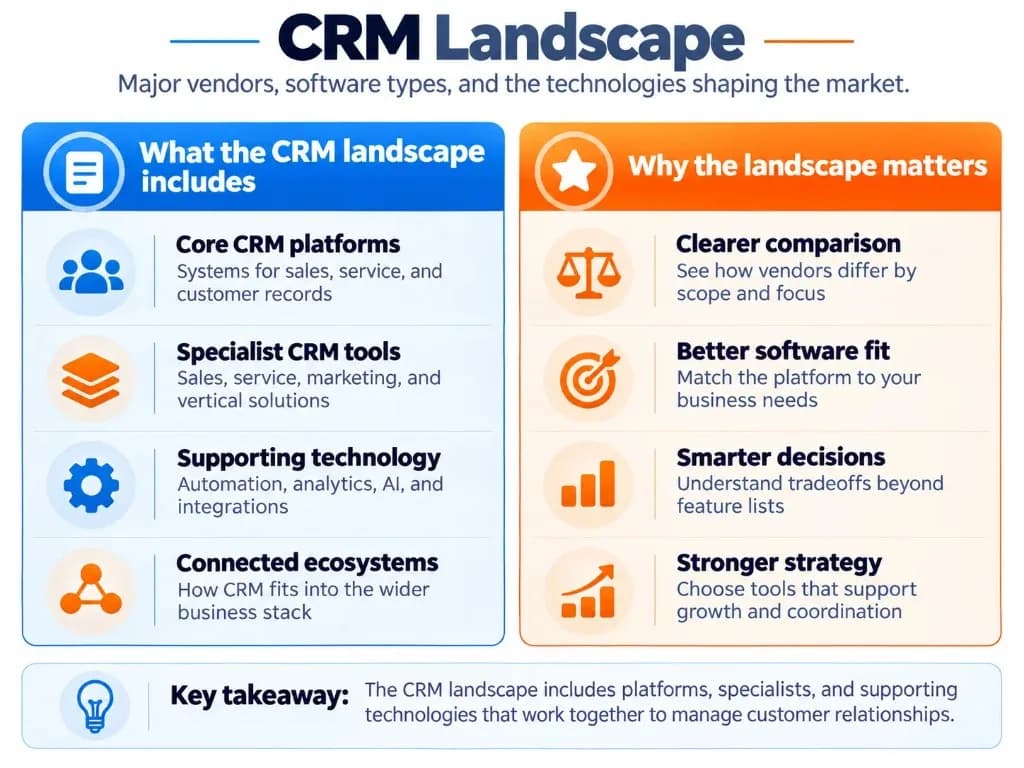
The CRM landscape describes how the customer relationship management software market is organized, including the providers competing within it, the customers they serve, and the technologies that differentiate their products.
It covers three interconnected areas:
- CRM platforms: Systems that manage customer records, relationships, sales opportunities, and associated business processes.
- CRM application segments: Software focused on particular customer-facing functions or industry requirements.
- Supporting technologies: Integrations, analytics, automation, customer data infrastructure, and AI tools that extend CRM capabilities.
The distinction matters because not every product associated with customer relationships is a complete CRM system. A marketing automation platform, for instance, may connect to a CRM without replacing its core customer-record and relationship-management functions—common in CRM for digital marketing stacks.
The CRM landscape is therefore broader than a list of software brands but narrower than the entire customer experience technology industry.
How Is the CRM Software Market Organized?
The CRM market can be understood through three overlapping dimensions: functional scope, customer or industry specialization, and platform architecture.
These dimensions are not mutually exclusive. One vendor may provide enterprise CRM, specialized sales applications, and an integrated technology platform—sometimes as cloud-based CRM, sometimes as a hybrid of apps and on-prem connections.
Core CRM Platforms
Comprehensive CRM platforms provide a foundation for managing customer information and coordinating multiple customer-facing activities.
They generally fall into three overlapping market segments:
| Market segment | Typical positioning | Representative vendors |
|---|---|---|
| Enterprise CRM | Extensive customization, governance, integration, and cross-functional operations | Salesforce, Microsoft Dynamics 365, Oracle, SAP |
| Small-business and mid-market CRM | More accessible deployment and everyday relationship management, with varying levels of scalability | HubSpot, Zoho CRM, Pipedrive |
| Configurable CRM platforms | Flexible data models, workflow design, and business-specific applications | Creatio, Salesforce, Microsoft Dynamics 365 |
These categories describe common market positioning, not rigid limitations. A large vendor may serve small businesses, while a mid-market platform may support sophisticated organizations that still need clean CRM data entry and strong CRM system proficiency.
Functional, Industry-Specific, and Emerging CRM Products
Other providers differentiate themselves through a particular function, industry, or technology approach.
Functional CRM applications focus on areas such as sales, marketing, or customer support. Pipedrive emphasizes sales pipeline management, while Zendesk specializes in service operations. Some products in these categories provide core CRM capabilities; others work alongside a separate CRM—similar to how CRM for service businesses or CRM for call centers pick tools for ticket-heavy work.
Industry-specific CRM platforms incorporate specialized data structures and workflows. Veeva Vault CRM, for example, serves life sciences organizations with capabilities designed around pharmaceutical CRM and healthcare professional engagement. Parallel patterns appear in CRM for insurance agents, CRM for real estate, CRM for manufacturing, CRM for retail, CRM for government, and CRM for finance teams that need sector-specific records.
AI-native CRM platforms emphasize AI and flexible data models as foundational parts of their product design. Attio is an example of a provider positioning itself in this emerging segment.
The advantage of specialization is greater alignment with a particular requirement. The tradeoff may be a narrower functional scope or increased dependence on CRM integrations. When templates cannot model the process, teams sometimes evaluate custom CRM development or broader CRM development options.
Adjacent Technologies in the CRM Ecosystem
The wider CRM technology landscape also includes tools that complement CRM systems.
Technology
Relationship to CRM
Customer data platforms (CDPs)
Unify customer data from multiple sources for activation and analysis
Marketing automation
Orchestrates campaigns and engagement, sometimes as part of a CRM suite
Revenue intelligence
Analyzes sales interactions, pipeline signals, and revenue performance
Customer service platforms
Manage support operations and may include CRM records or integrate with an existing CRM
Integration platforms
Connect CRM data and workflows with other business applications
A CDP or revenue intelligence tool should not automatically be classified as a complete CRM simply because it manages customer-related information. The same caution applies when comparing operational CRM workflows with analytics layers that sit beside the CRM database.
Major CRM Vendors and Their Market Positions
The CRM vendor landscape contains established platform providers, smaller specialists, and newer competitors built around different approaches to data and automation.
The following comparison identifies representative vendors rather than ranking them from best to worst.
| Vendor | Main market position | Key distinction |
|---|---|---|
| Salesforce | Broad enterprise CRM ecosystem | Extensive sales, service, data, automation, and AI offerings |
| Microsoft Dynamics 365 | Enterprise CRM applications | Integration with Microsoft's business and productivity ecosystem |
| Oracle | Enterprise sales and customer experience | Broad enterprise applications and integration capabilities |
| SAP | Enterprise customer experience | Connections to enterprise business processes and SAP systems |
| HubSpot | Unified customer platform | Shared CRM foundation with connected marketing, sales, and service applications |
| Zoho CRM | Small-business to enterprise CRM | Broad CRM functionality across multiple editions and a wider business software suite |
| Pipedrive | Sales-focused CRM | Visual pipeline management and sales-team workflows |
| Zendesk | Customer service software | Support and service capabilities, including CRM-related functions |
| Creatio | Configurable CRM platform | No-code workflow and application configuration |
| Veeva Vault CRM | Industry-specific CRM | Life sciences workflows and specialized customer engagement |
| Attio | AI-native, flexible CRM | Configurable records and AI-supported relationship intelligence |
Vendor categories are overlapping. A provider's positioning should not be treated as a permanent limitation on its products or target customers. Teams comparing CRM software features should still verify plan limits, permissions, and what a CRM system administrator can configure without add-ons.
How Concentrated Is the CRM Market?
The CRM market has a clear revenue leader but remains highly fragmented.
According to IDC's Worldwide Semiannual Software Tracker, published in April 2026 using 2025 market data, Salesforce held 20.0% of the worldwide CRM applications market. Oracle held 4.1%, Microsoft 4.0%, Adobe 3.4%, and SAP 3.1%, leaving approximately 65.4% for other vendors combined.
These figures measure vendor revenue share under IDC's defined market methodology. They do not measure customer satisfaction, product quality, number of installations, or suitability for a particular organization—including B2B CRM pipelines, ecommerce CRM practical strategies, telecom CRM case history, or constituent CRM programs.
The large combined share held by other providers illustrates why smaller and specialist vendors remain an important part of the competitive landscape.
Source: Salesforce's June 2026 announcement citing IDC.
Technologies Behind Modern CRM Platforms
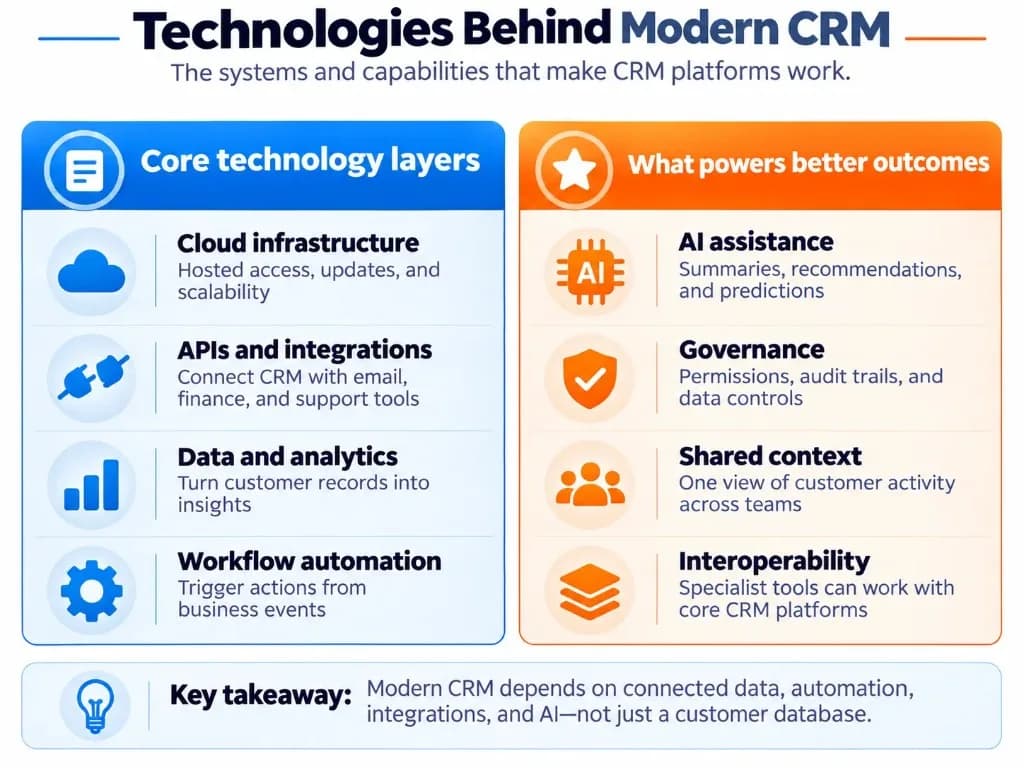
Modern CRM systems depend on several connected technologies rather than customer databases alone.
| Technology | Role in the CRM landscape |
|---|---|
| Cloud infrastructure | Supports hosted applications, remote access, and platform updates |
| APIs and integrations | Exchange information with email, finance, commerce, support, and other systems |
| Data management and analytics | Maintain customer context and support reporting or predictive insights |
| Workflow automation | Execute defined actions when customer or business events occur |
| AI and machine learning | Support predictions, summaries, recommendations, and conversational interfaces |
| Security and governance | Control access, data use, auditability, and automated actions |
The important distinction is how these technologies work together.
For example, an AI assistant may summarize a customer interaction, but its usefulness depends on having access to accurate, appropriately authorized customer information—often captured in CRM notes and kept current through disciplined CRM data entry. Integration capabilities determine whether that context is available across applications once teams learn how to connect a CRM.
This creates two broad architectural approaches:
Integrated suites provide multiple capabilities within one vendor ecosystem. They can simplify coordination and shared data management, although the organization becomes more dependent on that provider's architecture and commercial terms.
Connected specialist applications combine products from different providers. They allow more focused technology choices but require effective integration, data synchronization, and governance.
Neither architecture is universally superior. Both can be effective when the technology stack matches the organization's requirements and CRM metrics stay trustworthy.
For a deeper explanation of the underlying connections, see a dedicated guide to CRM integrations—or start with how to connect a CRM for a practical walkthrough.
CRM Landscape Trends in 2026
1. Embedded AI, AI-Native CRM, and Autonomous Agents
AI is one of the most significant forces changing the CRM competitive landscape, but AI-powered CRM products do not all work in the same way.
Three approaches are particularly relevant:
- AI-enabled CRM: Established CRM platforms incorporate AI into existing applications for tasks such as summaries, predictions, and recommendations.
- AI-native CRM: Providers design their products around AI-supported data management and workflows from the outset.
- Agentic CRM: AI agents can carry out defined multistep activities using customer information, connected tools, and organizational rules.
Salesforce's Agentforce, Microsoft's Copilot-connected Dynamics 365 capabilities, and Attio's AI Attributes demonstrate different approaches to integrating AI into customer-facing work, including CRM for inside sales motions that depend on fast follow-up.
These categories can overlap. An established CRM can introduce autonomous agents, while an AI-native provider can also offer conventional CRM functionality.
Gartner's July 2026 Hype Cycle for CRM Technologies identifies agentic capabilities as a major development affecting marketing, sales, service, and commerce.
However, autonomous capabilities require reliable data, appropriate permissions, and controls over what agents can do independently. Product demonstrations should not be mistaken for evidence that every advertised capability is generally available or suitable for unsupervised use—another reason CRM consulting discovery matters before buying AI add-ons.
2. Integrated Platforms and Specialist Providers Continue to Compete
CRM vendors are expanding their offerings across more customer-facing activities, while specialists continue to develop deeper capabilities for particular teams or industries.
Forrester's October 2026 State of CRM research describes CRM increasingly as a portfolio of related customer-facing technologies rather than one isolated application.
This means businesses face an architectural choice as well as a vendor choice.
A comprehensive platform may offer common data, consistent governance, and fewer integration points. A specialized application may provide more targeted workflows or a more suitable user experience for a particular team—for example CRM for manufacturing dealer accounts versus a general sales CRM.
The competitive distinction is increasingly about how well applications work together, not simply the number of features each vendor offers. That is also where CRM vs project management debates appear when delivery tools are mistaken for relationship systems.
3. Conversational Interfaces Are Changing How People Access CRM
CRM software has traditionally required employees to open the application, locate records, and enter updates through forms and dashboards.
AI-powered interfaces increasingly allow users to retrieve information and initiate CRM actions through natural-language interactions in other business applications.
On October 8, 2026, Microsoft announced new Dynamics 365 CRM capabilities for Copilot and Teams, including ways to access customer context and perform CRM-related work within productivity environments.
This illustrates an important direction: the CRM can remain the authoritative system for customer records while users interact with that information through another interface.
Some of Microsoft's announced capabilities were generally available, while others remained in preview. The trend is meaningful, but availability should always be checked at the specific product and feature level—and a CRM system administrator should confirm permissions before rollouts.
4. AI Costs and Data Governance Are Becoming Stronger Differentiators
Traditional CRM comparisons often emphasize features, licensing, and customization. AI introduces additional considerations.
Depending on the provider and contract, AI functionality may involve separate subscriptions, consumption-based charges, usage allowances, or other restrictions.
Organizations also need to evaluate:
- Which customer records and external information AI can access.
- Whether automated changes require human approval.
- How agent activity is logged and audited.
- Whether sensitive information is protected across integrations.
- How usage affects the total cost of ownership.
These questions matter because a CRM with advanced AI capabilities is not necessarily more economical or operationally appropriate than a simpler system that still supports business growth with accurate records.
How to Interpret the CRM Vendor Landscape
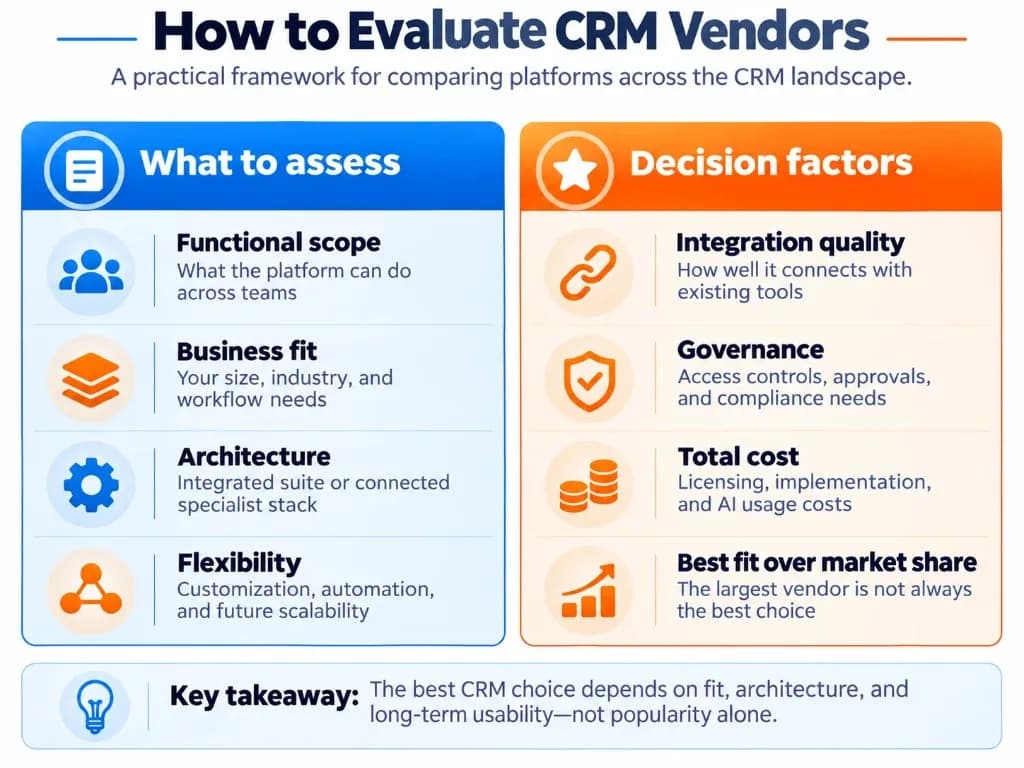
CRM market maps, analyst rankings, and vendor comparisons are useful starting points, but they measure different aspects of the market.
A practical comparison should consider five factors:
| Factor | Question to ask |
|---|---|
| Functional scope | Is the product a complete CRM platform, a specialized CRM, or an adjacent application? |
| Market fit | Does it target the organization's size, industry, and operational requirements? |
| Architecture | Does it provide an integrated suite or depend on connected applications? |
| Flexibility and governance | Can the product support necessary changes, integrations, access controls, and data requirements? |
| Commercial fit | Do licensing, support, implementation, and AI usage costs make sense for the intended scope? |
These criteria help explain why the largest CRM vendor, the highest-ranked product, and the most suitable platform may be different—especially across CRM industry examples where workflows diverge.
A small sales team may benefit from a focused system that provides a straightforward pipeline. A multinational organization may need extensive integrations, governance, and customization. A pharmaceutical company may prioritize specialized workflows that general-purpose systems do not provide without additional configuration.
Market-share figures also require context. A revenue-based ranking cannot establish that a vendor has the most customers, the highest satisfaction, or the best AI capabilities. Similarly, an analyst report's ranking depends on its inclusion criteria and scoring methodology.
The most useful way to understand the CRM landscape is to examine vendors across three dimensions: what functions they cover, which customers they specialize in, and how their technology connects with the wider business ecosystem.
That framework explains both the established structure of the CRM market and why AI, specialist applications, and new software architectures continue to reshape it.
Frequently Asked Questions
How many CRM software vendors are there?
There is no universally accepted count because CRM directories classify vendors, products, and specialized applications differently. As of November 2026, G2 lists 2,835 products in its CRM software category, but these are not necessarily unique vendors. The market includes established providers, niche platforms, and emerging competitors—from CRM for retail tools to enterprise suites.
Will AI eventually replace traditional CRM software?
AI is more likely to transform traditional CRM software than eliminate it. AI agents can automate record updates, retrieve customer information, and handle routine activities, but businesses still need reliable customer databases, permissions, and workflow controls. The biggest change may be how employees interact with CRM systems rather than whether those systems exist—CRM system proficiency still matters.
Which AI capabilities actually provide value in CRM platforms?
AI-powered conversation summaries, automatic record updates, duplicate detection, and lead prioritization can provide practical value by reducing administrative work. However, their effectiveness depends on data quality, integration reliability, and the accuracy of AI-generated outputs. Businesses should evaluate measurable improvements in CRM metrics rather than assuming every AI feature justifies an additional subscription.
Is an industry-specific CRM better than a general-purpose CRM?
An industry-specific CRM is generally more suitable when a business needs specialized workflows, data structures, or regulatory capabilities that general-purpose platforms cannot easily support. For example, life sciences companies may benefit from Veeva Vault CRM's specialized pharmaceutical CRM functionality. General-purpose systems can be more flexible when industry requirements are straightforward or likely to change—see CRM industry examples for how sectors differ.
Can a company use multiple CRM systems instead of one platform?
Yes, companies can use multiple CRM systems, particularly when different departments or business units have specialized requirements. However, maintaining separate platforms can create duplicate records, inconsistent customer information, and additional integration costs. A shared system of record and reliable data synchronization become essential when multiple CRMs operate together—another case for knowing how to connect a CRM carefully.
How can businesses avoid vendor lock-in when choosing a CRM?
Businesses can reduce vendor lock-in by prioritizing data portability, documented APIs, flexible integrations, and transparent contract terms. They should also examine whether custom workflows, automation, and customer records can be transferred to another platform without extensive redevelopment. The lowest subscription price may not offer the lowest long-term switching cost—CRM consulting and export testing during CRM implementation can surface those risks early.